Any emotion, if it is sincere, is involuntary.
Mark Twain
Wednesday, January 17, 2007


Tuesday, January 16, 2007
The Michael Caine Axiom
Michael Caine asserts that if you're working too hard, you're not doing it right. Well, I think part of the problem I've had finishing films has had a lot to do with the what I've completed on set. I've long agonized on things coming together, having seen many projects languish over the years. Earlier on I missed a lot: I never slated shots, I didn't understand transistions and coverage, problems with sound, sound, sound. One of the biggest problems I had was with the writing. I tried to do too much with the story. I wasn't skilled enough to let it be simple. If you asked me what something was about, I gave a convoluted plot and thematic summary, rather than a simply stated premise. I've long heard that successful films are about one thing. My films were much deeper than that; I mean why say it simply when you can make it complicated? In terms of coverage, I either didn't know how to do it very well. Again, why take the time to understand film grammar? I'm way smarter than that. More notoriously, I held the arrogant opinion that I could forego coverage by letting the action play out in the master or, even worse, cut the film in the camera. Just about every filmmaker I know that cuts in the camera makes very wooden and mannered films. Too many of us have been seduced by the Robert Rodriquez mythos. The few filmmakers that let things play out in the master successfully are bona fide masters such as Woody Allen, Billy Wilder, Andrei Tarkovsky and most masterfully of all, Hou Tsien Tsien. I'm not ready to make worthwhile attempts at that just yet.
Not a single film since my first film, Nora Mae, has cut together easily. Until now. With the new technology of P2 cards, logging and digitizing is a much more direct task. Especially when every shot is slated. Now all that has to be done is select the take I like for each shot, set in and out points and drop it in the timeline. Right on down the shot list. There's no anguish, because the story is elegantly simple and was pre-visualized well - storyboards and test shots. Transistions were well considered in pre-visualiztion, too. So I don't have to work too hard to get a rough cut. If I decide to get tricky later on, that will be a choice rather than a compromise. All this bluster isn't to say it's a perfect film. I'm no longer concerned with making a perfect film and what that could do for my vaunted career. Klepto is just a little exercise in making movies that I'm going to finish and let whomever sees it judge it for themselves.
One more thing saved me from a hellish post-production relationship with this project -- no sound. Klepto is a non-verbal film. There's a temp track of location sound for reference, but I plan to record and build a soundtrack after I have a cut. Come to think of it, Nora Mae was the same deal. I'm feeling a bit exposed and vulnerable to admit that after all these years I still can't make a sound-sync film without having to work too hard. Alack, I am who I am and I am where I'm at. Oh, the pain of getting ahead of oneself. Good thing it's never too late to start over. All the better since I have all the experience of failed past attempts at a number of projects beyond my abilities. Oh, the joy of being a human learning to make films.
Anyway, Klepto should be finished within the next week or two if I can continue to embrace its imperfections and enjoy the progress I've made as a filmmaker by being right-sized.
Humbly yours,
Signore Direttore
Not a single film since my first film, Nora Mae, has cut together easily. Until now. With the new technology of P2 cards, logging and digitizing is a much more direct task. Especially when every shot is slated. Now all that has to be done is select the take I like for each shot, set in and out points and drop it in the timeline. Right on down the shot list. There's no anguish, because the story is elegantly simple and was pre-visualized well - storyboards and test shots. Transistions were well considered in pre-visualiztion, too. So I don't have to work too hard to get a rough cut. If I decide to get tricky later on, that will be a choice rather than a compromise. All this bluster isn't to say it's a perfect film. I'm no longer concerned with making a perfect film and what that could do for my vaunted career. Klepto is just a little exercise in making movies that I'm going to finish and let whomever sees it judge it for themselves.
One more thing saved me from a hellish post-production relationship with this project -- no sound. Klepto is a non-verbal film. There's a temp track of location sound for reference, but I plan to record and build a soundtrack after I have a cut. Come to think of it, Nora Mae was the same deal. I'm feeling a bit exposed and vulnerable to admit that after all these years I still can't make a sound-sync film without having to work too hard. Alack, I am who I am and I am where I'm at. Oh, the pain of getting ahead of oneself. Good thing it's never too late to start over. All the better since I have all the experience of failed past attempts at a number of projects beyond my abilities. Oh, the joy of being a human learning to make films.
Anyway, Klepto should be finished within the next week or two if I can continue to embrace its imperfections and enjoy the progress I've made as a filmmaker by being right-sized.
Humbly yours,
Signore Direttore
Monday, January 15, 2007
The Master Says 114
Every once in a while, when the audience is expecting to see one thing, you have to show them something else.
Conrad Hall
Conrad Hall
Sunday, January 14, 2007
Klepto
A chronic petty thief extends the pain of his affliction to a co-worker who gives him a ride home.
We shot the film today. All thirty-one shots, many of them in a moving vehicle on city streets. Everything takes so much longer when shooting with vehicles. Also it was a sunny day contrary to the weather forecast earlier in the week. So I didn't plan on having to limit our driving with respect to shadows. I was looking forward to an overcast, low-contrast look, but the sunlight gave us some nice flares, interesting shadows and very deep focus.
It was a hectic day as I knew it would be. Things went well - of course there were the usual frustrations, but they were minor and didn't hold us up too much. I overbooked myself as is not uncommon. I did a lot of rigging, producing, dolly gripping, camera assisting, art direction and assistant directing. I guess I was transpo captain as well. I also managed to do a bit of directing. I liked what we shot. I think the actors did a fine job as did our tiny crew which consisted of a make-up artist and a very helpful but inexperienced grip. (I missed Efrem's intuitive multi-tasking abilities, but he was on a paying job.)
In some ways I feel like I'm developing some bad habits by doing so much myself. I was sucessful at letting Jordan frame the shots and keeping my hands off the camera in that sense. I'm afraid that the times that I got frustrated or needed to remind everyone that we had to move it didn't support the actors as well as I think they deserve. I'm not going to be too hard on myself. I didn't yell at anyone and I treated everyone with respect. It's something I always want to improve upon. I really want to be able to say, Great, now let's try it this way. I have a terrible habit of pointing out what didn't go right. Even though I've mananged to reduce the frequency that I do it and do it a kinder tone than in the past, I want to stop doing it altogether.
We were shooting a few shots at a bus stop, which prompted TriMet to issue a 9-1-1 alert. Apparently there's some concern that any filming near public transportation is possibly a terrorist cell at work. It struck me as a bit absurd, however the man that confronted us was very kind and allowed us to continue shooting, so I shouldn't complain too much about it.
One of the things that I really enjoyed today was that my ego didn't seem to be too involved. I was in the process of doing a job that I'm getting better at. I wasn't thinking of the results. Nor was I ever conscious of demonstrating how impressive I am as a filmmaker. I don't like to admit that I've tended toward narcissism all too frequently in the past. Poseur!
Another challenge was being forced to think on my feet about a few shots under extreme pressure. We had limited hours of daylight and we were running a half hour behind after the first hour. In the end we wrapped fifteen minutes early, so we must have been doing something right. Anyway, one of the things that frustrated me on But A Dream was feeling turned around as we moved around the location from shot to shot. Today I was better at keeping things straight. And I let go a bit more. Maybe it had to do with the fact that BAD cost seven thousand dollars to get in the can while Klepto set me back about seventy bucks.
I'm definitely getting better at shooting the films. The next challenge is finishing them.
Exhausted,
Signore Direttore
We shot the film today. All thirty-one shots, many of them in a moving vehicle on city streets. Everything takes so much longer when shooting with vehicles. Also it was a sunny day contrary to the weather forecast earlier in the week. So I didn't plan on having to limit our driving with respect to shadows. I was looking forward to an overcast, low-contrast look, but the sunlight gave us some nice flares, interesting shadows and very deep focus.
It was a hectic day as I knew it would be. Things went well - of course there were the usual frustrations, but they were minor and didn't hold us up too much. I overbooked myself as is not uncommon. I did a lot of rigging, producing, dolly gripping, camera assisting, art direction and assistant directing. I guess I was transpo captain as well. I also managed to do a bit of directing. I liked what we shot. I think the actors did a fine job as did our tiny crew which consisted of a make-up artist and a very helpful but inexperienced grip. (I missed Efrem's intuitive multi-tasking abilities, but he was on a paying job.)
In some ways I feel like I'm developing some bad habits by doing so much myself. I was sucessful at letting Jordan frame the shots and keeping my hands off the camera in that sense. I'm afraid that the times that I got frustrated or needed to remind everyone that we had to move it didn't support the actors as well as I think they deserve. I'm not going to be too hard on myself. I didn't yell at anyone and I treated everyone with respect. It's something I always want to improve upon. I really want to be able to say, Great, now let's try it this way. I have a terrible habit of pointing out what didn't go right. Even though I've mananged to reduce the frequency that I do it and do it a kinder tone than in the past, I want to stop doing it altogether.
We were shooting a few shots at a bus stop, which prompted TriMet to issue a 9-1-1 alert. Apparently there's some concern that any filming near public transportation is possibly a terrorist cell at work. It struck me as a bit absurd, however the man that confronted us was very kind and allowed us to continue shooting, so I shouldn't complain too much about it.
One of the things that I really enjoyed today was that my ego didn't seem to be too involved. I was in the process of doing a job that I'm getting better at. I wasn't thinking of the results. Nor was I ever conscious of demonstrating how impressive I am as a filmmaker. I don't like to admit that I've tended toward narcissism all too frequently in the past. Poseur!
Another challenge was being forced to think on my feet about a few shots under extreme pressure. We had limited hours of daylight and we were running a half hour behind after the first hour. In the end we wrapped fifteen minutes early, so we must have been doing something right. Anyway, one of the things that frustrated me on But A Dream was feeling turned around as we moved around the location from shot to shot. Today I was better at keeping things straight. And I let go a bit more. Maybe it had to do with the fact that BAD cost seven thousand dollars to get in the can while Klepto set me back about seventy bucks.
I'm definitely getting better at shooting the films. The next challenge is finishing them.
Exhausted,
Signore Direttore
Saturday, January 13, 2007
The Master Says 113
I think people who have faults are a lot more interesting than people who are perfect.
Spike Lee
Spike Lee
Friday, January 12, 2007
Thursday, January 11, 2007
Wednesday, January 10, 2007
The Master Says 112
In other words, I am interested in a river only if a bridge crosses it.
Nestor Almendros
Nestor Almendros
Tuesday, January 09, 2007
The Master Says 111
Some actors are very intelligent, but is not necessarily with their intelligence that they act.
jean Renoir
jean Renoir
Sunday, January 07, 2007
The Master Says 110
The stage is life, music, beautiful girls, legs, breasts, not talk or intellectualism or dried-up academics.
Harold Clurman
Harold Clurman
Saturday, January 06, 2007
Playing It Fast (and Sappy)
It's time to admit something: I have always loved heightened and melodramatic language in film. I'm not eager to admit it as I've long been seduced by the postures and trappings of realism and naturalism. I like what Mamet says about this topic, something about people going to see film and theater to hear things said that they would love to get away with in life. I think this is why I prefer Fassbinder to Cassavetes. Scorcese has always been a favorite, too. Of course it's his actions that are more operatic, but there are lines delivered by DeNiro - aka The King of the Mumbling Method Men - that may seem ordinary and naturalistic that are truly contrived. I'm thinking of his job interview in Taxi Driver - "Anytime, anywhere." Come to think of it, Taxi Driver is a great big fat lady of a melodrama. "You talking to me?" Come on, that's pure Kabuki. And I love it! As much now as I did when my mom and I used to act it out back in 1977. (How can I not be a melodrama fan if one of my fondest memories of childhood is imitating Travis Bickle with my mom?)
Another of my favorite films is Sweet Smell of Success, which was a box-office failure ironically. It's so heightened, it's borderline camp. Clifford Odet's rewrote Ernest Lehman's original screenplay. I love Odets, but whenever I assigned his plays at my acting studio, actor-students complained. Most of them were too intent on playing everything natural. Playing it natural usually means grinding everything to a slow, methodical (Aha! There's it is: method/methodical!!!) destruction of any dramatic tension. Odets's writing doesn't work that way. He understood it very well, "My dialogue may seem overwritten, too wordy, too contrived. Don't let it worry you. You'll find that it works if you don't worry too much about the lines themselves. Play the situations, not the words. And play them fast."
Now that I think about it, it's not only good advice at getting the seemingly preposterous to play, it's pretty truthful. In life, we often have to speak fast if we want to be heard. Maybe not in a town as laid back as Portland, but in New York for sure. If you want to get your two cents in, you had better be sharp and quick.
This month's short, Klepto, is a film without dialogue. I am trying to design the shots so that the tiny little movements of the compulsive thief's hands play on a grand scale. I'm looking to Sergio Leone for inspiration - all those moments of anticipation such as the beginning of Once Upon a Time in the West.
Next month's short, Friends of Bill, has a highly improbable set up with a lot of heightened language. I'll have to remember Odets's advice.
2007 is off to a good start. Getting my daily meditation and exercise. No fiction reading as yet, but I did put a collection of TC Boyle stories on my nightstand. My new camera is being used as I write on Holly & Grace's newest endeavor. I stopped by set yesterday and saw the camera with the Mini35 adapter on it. Jordan and I get to do a camera test with that tomorrow night after they wrap. I'm very excited to see the results. For those of you who might not know what a Mini35 is -- it's a device that allows 35mm cine lenses to be mounted to a digital camcorder. You get much improved optics and the power of selective focus.
What else? We're shooting Klepto next weekend, so I've been busy location scouting and storyboarding that. The walks I've been taking in the industrial area around Holgate have been inspriring. There's talk of a WalMart going in over there. Hopefully the significant oppostion to that will prevail.
And we booked a lucrative three-day, two-camera shoot for a director out of New York. It's some sort of teacher training CD-ROM. Not too painful. Perhaps even an opportunity to learn something.
I got to speak to Eric Edwards on the phone the other day, he seems to be a very nice man. He's shooting a short that the French invited Gus Van Sant to make to play at Cannes this spring. I was able to drop by the set for a brief visit yesterday.
Lastly, I saw Notes on a Scandal last night. Can't go wrong seeing that one. Pretty easy to get lost in the performances -- Dame Judi is amazing as always, Cate Blanchett continues to mesmerize and Bill Nighy is a gem.
A Big Pizza Pie,
Signore Direttore
Another of my favorite films is Sweet Smell of Success, which was a box-office failure ironically. It's so heightened, it's borderline camp. Clifford Odet's rewrote Ernest Lehman's original screenplay. I love Odets, but whenever I assigned his plays at my acting studio, actor-students complained. Most of them were too intent on playing everything natural. Playing it natural usually means grinding everything to a slow, methodical (Aha! There's it is: method/methodical!!!) destruction of any dramatic tension. Odets's writing doesn't work that way. He understood it very well, "My dialogue may seem overwritten, too wordy, too contrived. Don't let it worry you. You'll find that it works if you don't worry too much about the lines themselves. Play the situations, not the words. And play them fast."
Now that I think about it, it's not only good advice at getting the seemingly preposterous to play, it's pretty truthful. In life, we often have to speak fast if we want to be heard. Maybe not in a town as laid back as Portland, but in New York for sure. If you want to get your two cents in, you had better be sharp and quick.
This month's short, Klepto, is a film without dialogue. I am trying to design the shots so that the tiny little movements of the compulsive thief's hands play on a grand scale. I'm looking to Sergio Leone for inspiration - all those moments of anticipation such as the beginning of Once Upon a Time in the West.
Next month's short, Friends of Bill, has a highly improbable set up with a lot of heightened language. I'll have to remember Odets's advice.
2007 is off to a good start. Getting my daily meditation and exercise. No fiction reading as yet, but I did put a collection of TC Boyle stories on my nightstand. My new camera is being used as I write on Holly & Grace's newest endeavor. I stopped by set yesterday and saw the camera with the Mini35 adapter on it. Jordan and I get to do a camera test with that tomorrow night after they wrap. I'm very excited to see the results. For those of you who might not know what a Mini35 is -- it's a device that allows 35mm cine lenses to be mounted to a digital camcorder. You get much improved optics and the power of selective focus.
What else? We're shooting Klepto next weekend, so I've been busy location scouting and storyboarding that. The walks I've been taking in the industrial area around Holgate have been inspriring. There's talk of a WalMart going in over there. Hopefully the significant oppostion to that will prevail.
And we booked a lucrative three-day, two-camera shoot for a director out of New York. It's some sort of teacher training CD-ROM. Not too painful. Perhaps even an opportunity to learn something.
I got to speak to Eric Edwards on the phone the other day, he seems to be a very nice man. He's shooting a short that the French invited Gus Van Sant to make to play at Cannes this spring. I was able to drop by the set for a brief visit yesterday.
Lastly, I saw Notes on a Scandal last night. Can't go wrong seeing that one. Pretty easy to get lost in the performances -- Dame Judi is amazing as always, Cate Blanchett continues to mesmerize and Bill Nighy is a gem.
A Big Pizza Pie,
Signore Direttore
Friday, January 05, 2007
The Master Says 108
The thing about not reading scripts and my wanting a director to tell me a story is a risk I need to take. I need that real fear.
Judi Dench
Judi Dench
Monday, January 01, 2007
2007 Resolutions
+ Make lots of mistakes
+ Write, Shoot and Edit 1 short film each month
+ Acknowledge, accept and embrace fear and resistance directly
+ Read more fiction
+ Daily Exercise - Not if, but what
+ Daily Meditation
+ Look at more paintings
+ Listen
+ Write, Shoot and Edit 1 short film each month
+ Acknowledge, accept and embrace fear and resistance directly
+ Read more fiction
+ Daily Exercise - Not if, but what
+ Daily Meditation
+ Look at more paintings
+ Listen
Sunday, December 31, 2006
Happy New Year
A very eventful year has come to a close. I learned a lot this year and end the year a better man than I started it.
This past week has been a real joy. Christmas morning with the family, of course. Had the week off. Went to see some films (Volver +++++ Little Children ++++ Eragon phtwww) and out for meals with friends and family. Sold some more equipment and bought a new HD camera. Wrote the final twenty-five pages on a new script in the past three days. Had two very illuminating and encouraging meetings about an upcoming project. Even made it to the gym.
It's been a great week to close out a tough, but wonderful year.
I'm feeling rested and ready for all that 2007 has in store for us.
¡viva!
signore direttore
This past week has been a real joy. Christmas morning with the family, of course. Had the week off. Went to see some films (Volver +++++ Little Children ++++ Eragon phtwww) and out for meals with friends and family. Sold some more equipment and bought a new HD camera. Wrote the final twenty-five pages on a new script in the past three days. Had two very illuminating and encouraging meetings about an upcoming project. Even made it to the gym.
It's been a great week to close out a tough, but wonderful year.
I'm feeling rested and ready for all that 2007 has in store for us.
¡viva!
signore direttore
Friday, December 29, 2006
Thursday, December 28, 2006
The Master Says 106
The revolution is not an apple that falls when it is ripe. You have to make it fall.
Che Guevara
Che Guevara
Wednesday, December 27, 2006
A New Year's Resolution
This is who I want to be:
Me: I'm trying something new.
World: Aren't you scared?
Me: Yeah, ain't it great!
I want to fall on my ass and my face and learn to laugh about it.
I'm starting now by admitting that I'm scared.
Okay. The cat's out of the bag: I'm afraid.
Besitos,
Signore Direttore
Me: I'm trying something new.
World: Aren't you scared?
Me: Yeah, ain't it great!
I want to fall on my ass and my face and learn to laugh about it.
I'm starting now by admitting that I'm scared.
Okay. The cat's out of the bag: I'm afraid.
Besitos,
Signore Direttore
The Master Says 105
I've been terrified every day of my life but that's never stopped me from doing everything I wanted to do.
Georgia O'Keefe
Georgia O'Keefe
The Master Says 104
I also wanted to express the strength of cinema to hide reality, while being entertaining. Cinema can fill in the empty spaces of your life and your loneliness.
Pedro Almodovar
Pedro Almodovar
Tuesday, December 26, 2006
The Master Says103
Where have I come from? What am I doing here? What is it that I mean to achieve?
Konstantin Stanislavsky
Konstantin Stanislavsky
Sunday, December 24, 2006
Not Letting It Pass Me By
I have been a little anxious today as I always am around the holidays. I know I am not uniquely affected by the chaos, excitement, expectations and memories that come with Christmas. Each year I try to keep it more and more simple.
We had no last minute shopping to do. No party obligations. No extended family commitments.
I did some organizing - cleaned off my dresser, emptied some boxes of papers, put a piece of gear up for auction on eBay, cleaned up the spaghetti of cables and wires under the edit suite, wrapped a few gifts, watched football and took a nap.
I also put together the cutest little red tricycle. I did it this morning so as not to put it off until after the kids were in bed. I try to avoid that dad putting toys together until late on Christmas Eve cliche as much as possible. I realized that this little trike might be around for a while and that I'd only get to put it together once. I told myself not to let the moment pass me by. Everything shifted quite a bit after that. I was really doing what I was doing. It brought a moment of joy and peace to my day.
Merry Christmas,
nc
We had no last minute shopping to do. No party obligations. No extended family commitments.
I did some organizing - cleaned off my dresser, emptied some boxes of papers, put a piece of gear up for auction on eBay, cleaned up the spaghetti of cables and wires under the edit suite, wrapped a few gifts, watched football and took a nap.
I also put together the cutest little red tricycle. I did it this morning so as not to put it off until after the kids were in bed. I try to avoid that dad putting toys together until late on Christmas Eve cliche as much as possible. I realized that this little trike might be around for a while and that I'd only get to put it together once. I told myself not to let the moment pass me by. Everything shifted quite a bit after that. I was really doing what I was doing. It brought a moment of joy and peace to my day.
Merry Christmas,
nc
Saturday, December 23, 2006
The Master Says 102
Here I am trying to live, or rather, I am trying to teach the death within me how to live.
Jean Cocteau
Jean Cocteau
Friday, December 22, 2006
The Master Says 101
It must be the colors
And the kids
That keep me alive
'Cause the music is boring me to death
Cat Power
And the kids
That keep me alive
'Cause the music is boring me to death
Cat Power
Wednesday, December 20, 2006
The Master Says 100
Filmmakers should think less and use their imaginations more.
Alexander Mackendrick
Alexander Mackendrick
Tuesday, December 19, 2006
Monday, December 18, 2006
The Master Says 098
To grasp the full significance of life is the actor's duty, to interpret it is his problem, and to express it his dedication.
Marlon Brando
Marlon Brando
Sunday, December 17, 2006
Saturday, December 16, 2006
The Master Says 096
I like to write when I feel spiteful; it's like having a good sneeze.
D.H. Lawrence
D.H. Lawrence
Friday, December 15, 2006
The Master Says 095
The job is to ask questions - it always was - and to ask them as inexorably as I can. And to face the absence of precise answers with a certain humility.
Arthur Miller
Arthur Miller
Thursday, December 14, 2006
Wednesday, December 13, 2006
Five and Out
The time has come for me to end my five year career as an acting coach. Last night was the final class at the studio. I've decided to quit teaching in order to have more time and energy for other areas of my life. We went out with a month of very solid on-camera scene study. The past weeks have been very satisfying, allowing me to leave something which I've labored over and loved on a high note. The disappointment and surprise of the actor-students was humbling.
I thought of all the faces and personalities that have drifted through my studios over the past years as I cleaned out the storage closet and scrubbed the floor last night. I remembered the challenges and the laughs as well as the struggles and triumphs I witnessed and experienced over the years. I've grown as a person and as an artist as a result. I've gained some small measure of humility if only in the realization that I don't have to be all things to all people. Letting go of another hyphen in my occupation bio is a big step toward getting right-sized.
They say to teach is to learn a thing twice. My goal was never to be a better actor, but I do believe that all the things that make an actor better at his craft make him a better human being. I can say with confidence that I've done my best to show many the way toward making that a possiblilty in their lives. For everything that came to pass, both good and bad, it was my sincere effort at being present and truthful and that's always good enough. For that I am grateful.
Sincerely,
nc
I thought of all the faces and personalities that have drifted through my studios over the past years as I cleaned out the storage closet and scrubbed the floor last night. I remembered the challenges and the laughs as well as the struggles and triumphs I witnessed and experienced over the years. I've grown as a person and as an artist as a result. I've gained some small measure of humility if only in the realization that I don't have to be all things to all people. Letting go of another hyphen in my occupation bio is a big step toward getting right-sized.
They say to teach is to learn a thing twice. My goal was never to be a better actor, but I do believe that all the things that make an actor better at his craft make him a better human being. I can say with confidence that I've done my best to show many the way toward making that a possiblilty in their lives. For everything that came to pass, both good and bad, it was my sincere effort at being present and truthful and that's always good enough. For that I am grateful.
Sincerely,
nc
Tuesday, December 12, 2006
Saturday, December 09, 2006
The Master Says 093
I write scripts to serve as skeletons awaiting the flesh and sinew of images.
Ingmar Bergman
Ingmar Bergman
Wednesday, December 06, 2006
The Master Says 091
The hardest thing to learn is how to correct what's wrong without harming what's good.
Dede Allen
Dede Allen
Thursday, November 30, 2006
The Master Says 090
The present and the past coexist, but the past shouldn't be in flashback.
Alain Resnais
Alain Resnais
Wednesday, November 29, 2006
The Master Says 089
A Little shoeshine boy never gets low down
But he's got the dirtiest job in town
Bendin' low at the peoples' feet
On the windy corner of the dirty street
Well, I asked him while he shined my shoes
How'd he keep from gettin' the blues
He grinned as he raised his little head
Popped a shoeshine rag and then he said
Get rhythm when you get the blues
Come on, get rhythm when you get the blues
A jumpy rhythm makes you feel so fine
It'll shake all the trouble from your worried mind
Get rhythm when you get the blues
Johnny Cash
But he's got the dirtiest job in town
Bendin' low at the peoples' feet
On the windy corner of the dirty street
Well, I asked him while he shined my shoes
How'd he keep from gettin' the blues
He grinned as he raised his little head
Popped a shoeshine rag and then he said
Get rhythm when you get the blues
Come on, get rhythm when you get the blues
A jumpy rhythm makes you feel so fine
It'll shake all the trouble from your worried mind
Get rhythm when you get the blues
Johnny Cash
Tuesday, November 28, 2006
The Master Says 088
Movie directors, or should I say people who create things, are very greedy and they can never be satisfied, ... That's why they can keep on working. I've been able to work for so long because I think next time, I'll make something good.
Akira Kurosawa
Akira Kurosawa
Sunday, November 26, 2006
The Master Says 087
In theater, action is apt to be less a physical activity than a confrontation between characters, where the story progresses because of conflicts of personalities and verbal exchanges.
In film, what is happening now is likely to be less dramatically interesting than the action that may - or may not - be about to happen.
Alexander Mackendrick
In film, what is happening now is likely to be less dramatically interesting than the action that may - or may not - be about to happen.
Alexander Mackendrick
Saturday, November 25, 2006
Altman Interview
IT’S OKAY WITH ME
The Stop Smiling Interview with Robert Altman
By James Hughes
Midway through Robert Altman’s 1975 film Nashville, a bemused BBC reporter played by Geraldine Chaplin infiltrates the house party of Haven Hamilton, the crown jewel of Nashville’s music royalty. Regarding her majestic surroundings — a lush, tree-lined estate that looks more like a roadside stop from Wild Strawberries than the backwoods of Tennessee — Chaplin flatters her host by comparing the scene to a slice of Sweden’s premier auteur. “Bergman,” she cries. “Pure, unadulterated Bergman!” Taking one final glance at the locals — a honky-tonk group already tipsy on Jack Daniels — she revises her statement. “Of course the people are all wrong for Bergman, aren’t they?”
This small exchange, typically buried in a sound track dense with overlapping dialogue, encapsulates the essence of Robert Altman. His films have a European sensibility that echoes both the grandeur and the interior anguish of Ingmar Bergman and Federico Fellini. But the characters Altman chooses to occupy these arenas are quintessentially American. Faithful to his ever expanding stable of actors (Shelly Duvall, Michael Murphy, Lily Tomlin and Elliott Gould among them) Altman explores the lives of real people living in the forgotten recesses of a country often misrepresented by an overexposure of the two coasts. For over 50 years, Altman has created a cinematic landscape that stems from the heartland and branches out to every corner of the map: from the hazy Southwestern sprawl of California Split and 3 Women, through the clutter of Texas (Brewster McCloud and Dr. T and the Women) and quaintness of Kansas City, all the way up the bustling eastern seaboard, where the fictional presidential candidate Jack Tanner shamelessly canvassed for votes in ’88.
Robert Altman was born in Kansas City in 1925. After serving overseas in World War II, he returned to the Midwest and worked on industrial films for the Calvin Co. of Kansas City, eventually landing in the director’s chair for television series as diverse as “Alfred Hitchcock Presents” and “Bonanza.” With the success of MASH in 1970, Altman was tossed the keys to Hollywood’s most coveted projects, but chose instead to champion more personal films. Despite his continuous critical acclaim, he remains in the distinguished company of Alfred Hitchcock, Martin Scorsese and King Vidor — all Best Director nominees shut out five times by the Academy. But Altman seems unaffected by the allure of awards, and even more so by the demands and labels of the press. As Philip Marlowe would mumble in Altman’s exquisite adaptation of Raymond Chandler’s The Long Goodbye, “It’s okay with me.”
Fresh off a rebirth from Gosford Park in 2002, which catapulted him back into the public eye with the same force as The Player in 1991, Altman has recently seen some of his greatest unreleased works preserved on DVD, and he now embraces digital technology. His last two features — The Company and the just-wrapped A Prairie Home Companion — were shot on high-definition video. And, as Altman reveals from his well-equipped production office in Midtown Manhattan, he’s not surprised to see film become a thing of the past.
Stop Smiling: The film that you’ve just wrapped, A Prairie Home Companion, isn’t a documentary about the making of Garrison Keillor’s radio show, it’s a narrative that uses the show and its theater as a setting?
Robert Altman: Yes, it’s a drama about the demise of the radio show. The penultimate scene has Kevin Kline at the piano while the stage is being demolished.
SS: How was it working with Garrison Keillor?
RA: It was pretty good. It was tough on him — he’s been in charge for 30 years. This is the first time he’s done anything in which he is the content. And he’s always dealt in radio, so I had to put pictures up there. I have to give the audience something to look at. We could’ve shot the Keillor picture anywhere, but it was easier for all of us to shoot it in St. Paul, because that’s where it was based, and that stuff rubs off on you. It really rubs off on the people who live there and perform there. But we never left — we had two locations: a diner, which we shot in one night, and the rest of the time was all in the Fitzgerald Theater. We get a lot of cooperation in a city like St. Paul, because it’s a novelty to them, and they’re all very nice when you go to those small towns and small venues.
SS: Paul Thomas Anderson was brought on to be your back-up director. Did that work well?
RA: Yes. He was with me all the time. He’s a good friend of mine. I’m 80 years old. So they don’t insure me. On Gosford Park, which was the first time I did this, Stephen Frears was my stand-in. That’s all an insurance issue.
SS: How did you and P.T. Anderson meet?
RA: I’ve known Paul since he started, and he’s always been very generous about the origins of his work. Paul agreed to do it, which surprised and thrilled me. His girlfriend, Maya Rudolph, who was pregnant, was in the film as well. So that made things easier. It worked out well.
SS: There’s such a lack of regionalism in American entertainment today. You seem to be one of the few filmmakers who sets their films in smaller cities.
RA: I also try not to make all my films in Canada, and create that city that doesn’t exist anywhere. It’s dreadful what some filmmakers do. Most of my films I call arena films. I deal with a confined area — an arena — and I try to cover every aspect of it.
SS: You’ve had films set in larger cities like Los Angeles, but even then it’s treated almost like an alien environment.
RA: I’ve lived in New York for about 30 years, and I still meet people today who say, “Oh, you’re a Hollywood director.” That’s strange, because I’ve hardly ever made a film in that mold. I’ve never really been a New York director, either. That kind of mafia that runs New York, I never wanted to participate in that. As for Los Angeles, The Long Goodbye and California Split used that arena. Short Cuts was strictly L.A. I usually find that I don’t do road pictures; I need to have a cultural and geographical perimeter. Maybe that’s just the way I organize my thoughts, I need to contain them and contain my environment. Most of the time, it’s whatever interests me, whatever gets my attention at the time. It always ends up as the result of finding the right arena to do the film I’ve got in mind to do. The arena becomes a big part of it, because it fills the big part of it. I’ve done a lot pictures in small towns in the South. When you go to a unique area, I can do more with the stuff they have there. We try to use their culture, their colors, their music, their pride and prejudices.
SS: When the auteur theory came about in the mid-’60s, were you keeping an eye on how that movement was being shaped in the film journals overseas and then imported to the United States?
RA: I was focused on what I was doing and wanted to do. I was trying to make my own career and my own life’s work. Anything I felt helped in that area, I was interested in.
SS: Did the awakening of film writers and their duels in the press — Andrew Sarris battling Pauline Kael, for example — hold your attention at all?
RA: Pauline was a big help to me. She didn’t like a lot of my films. And when Pauline didn’t like my films, I didn’t like Pauline. When she did, I thought she was a genius. At times, I’d say, “What’s Kael going to think of this? What’s Judith Crist going to think of this?” The same is true today, because critics are the first press that you have to represent your work.
SS: So you took initial steps to guarantee that Kael would see your work early?
RA: Oh, yeah. She saw Nashville early. She jumped her deadline at The New Yorker, which helped cause a stir for the film. That was a controversy in itself. What she saw was the finished picture, although the story has it that what she saw was about three hours longer. There was some editing done on the picture since she saw it, but it was just tweaks. The critics were a force in the ’70s, but then the studio heads disappeared, so the filmmakers really were in charge. We could do pretty much what we wanted. I made Brewster McCloud at MGM — they couldn’t release it and they just dumped it, but the fact that it even got made is miraculous. Originally that script was terrible, and we reinvented it as we shot it. For me, the story has never been a concern. I like to literally save the idea, in a funny way. But at that time, I was being offered big, big movies, because it followed right after MASH. I said I didn’t want to make anything like that. I took a really low-budget project instead. I’ve done that all my life. If something works for you, you continue to do it. I did a bunch of pictures for 20th Century Fox when Alan Ladd was over there, but I set the budgets so low that they’d approve and I’d deliver the film. They would have no say in it, which is the kind of arrangement I liked.
SS: Was it your background in television and industrial films that kept you distanced from the theoretical side of filmmaking?
RA: I think it kept me more eclectic, in terms of venue and all that. I was always interested in shooting in places that I’d never been to before, and trying to use their assets. I find it hard to repeat myself, or consciously repeat myself. I can’t tell you how many times I was offered to do another MASH. I would always ask why. There was one, and that’s what I did. I despise the television show, because I think it was thematically the opposite of what the film was. For 12 years, it was about an Asian war. The enemy, no matter how you want to cut it or what platitudes you say, was always the guy with brown skin and narrow eyes.
SS: Were you constantly harassed during the reign of the show?
RA: I remember at my mother’s funeral, all of the ladies in the neighborhood in Kansas City baked some stuff. Afterward they caught me in the kitchen and said, “Oh, Mr. Altman. That MASH, we just love that.” I just said, “Oh, well. Thank you very much.” But they never saw what I did.
SS: When you were younger and watching films, did you keep track of directors and follow their releases?
RA: People have asked me throughout the years which directors have influenced me. I don’t know their names, because I was mostly influenced when I’d see a film and think, “Man, I want to be sure to never do anything like that.” So I never learned their names. It wasn’t a matter of copying or emulating somebody I admired. It was getting rid of a lot of stuff. I was impressed and affected by Bergman and Fellini and Kurosawa. My film Images was a big nod to Bergman, to Persona particularly. My whole sense of Kurosawa was light coming through trees, like in Rashomon. That film in particular was a favorite of mine. I liked a lot of the Italian films, some of the French. It went in circles — the British films were terrific for a while. There doesn’t seem to be room for everybody. Somebody comes in and occupies the art market, as I suppose it would be called, and then another group takes over.
SS: You once said, “The artist and the multitude are natural enemies.” How can you then explain working in so many popular mediums, like television, film, theater and opera?
RA: Opera cannot be considered a popular medium, and theater can hardly be, either. And most films can’t be. Television is still a popular medium. Movies are finished, aren’t they?
SS: You don’t just mean the steady decline of the box office?
RA: Just the general quality or character of the films being made. The marketing has always been to 14-year-old males. That’s one audience I’ve never had, or ever will have. Maybe it’s generational, maybe it’s just all past me and I don’t know it. But I just don’t see any films — or filmmakers, for that matter — coming along that interest me. I find the style of the films so silly. I’m surprised filmmakers can get away with all this. The corniness of most of these things — anyone who can even do it astonishes me.
SS: So it isn’t as much apathy from the audiences, it’s the fault of the filmmakers themselves?
RA: Well, no, the filmmakers are pushing themselves. It’s what they can get done, and now it’s all marketing. It went from the studio bosses ordering certain kinds of films to be made. Then the writers and filmmakers took over in the ’70s. The studio bosses disappeared. Then in the ’80s the agents started taking over. That was okay for a while. Then the marketing and advertising people took over, and now I don’t know who’s calling the shots. I don’t know any of the people who run the studios anymore. It’s pointless. What would I have to say to them anyway? We’re not in the same business. There’s no point in even getting in the same room together.
SS: Are you happy to reach an audience through whatever medium you can?
RA: When you go into opera and theater, you know you’re going into a limited stage, but it’s also a specialized stage. I don’t have to worry about the teenage boys anymore. But now we have a general level of intelligence in America that is considerably lower than it was 30 years ago. We’ve been dumbed down to a point where maybe some positive things will come around again, but I don’t even understand what they market as films these days. How do they do it? As I say, it’s probably me. I’m probably so out of touch with what’s going on.
SS: If there were a more thriving creative community in America, would film be the medium you would want to reach it through?
RA: Any kind of theater. Film is videotape now. There’s no need to use film anymore. You can use film to shoot your original material, and that film can be destroyed right after that, because it’s transferred to digital. At the end, when the digital is all dealt with, it’s put back to film. But that’s not the original film. The whole point of having to use film is because of the equipment that exists, and the egos of most of the artists, the cinematographers. If you took the top 10 cinematographers and I called them up, they’d say, “I’d love to work with you.” Then I’d say I wanted to shoot in high-def and they’d all say, “Oh, I don’t do that.” Well, why don’t they do that? It’s because they’ve made a big reputation by their manipulation of film. But film is just a medium. The picture that you see and the picture I see — how it gets from my mind to you, it’s of no consequence. It shouldn’t even be in the terms of discussion. I couldn’t have shot the Keillor picture, or The Company — the last two films I’ve made — on anything other than high-def. We shot Tanner on Tanner on regular video. We didn’t even get into high-def. The quality of the high-def can’t be beat. We were in this theater in St. Paul the whole time, and if you walked in there, you would not know that there was a motion picture going on, because you wouldn’t see any lights. You’d see a lot of cameras and cranes, but you wouldn’t see any lights.
SS: You’ve been burned more than anyone else by the effects of film deterioration — McCabe & Mrs. Miller being the obvious example. At the time you were making that film, it would’ve no doubt horrified you to think that, just a short time later, the original camera negative would be in such jeopardy.
RA: I was just on the edge of it. All of my films had been saved. There was a point when most of my films were not saved and couldn’t be, primarily because nobody knew who owned the negatives. It was only recently — because of Martin Scorsese and his film preservation efforts, along with a few things connected with some universities — where we went back and saved the films. They then go right onto video. But otherwise, if it hadn’t been for those efforts, you couldn’t see more than 10 of my films.
SS: As a format, DVD seems to be a particular lifesaver for you. Last year was a great year, in terms of previously unavailable films resurfacing. We saw Tanner ’88, Secret Honor, California Split and 3 Women.
RA: Oh, I know. And a lot of them weren’t out because of music clearances, or certain copyright problems. We had to make adjustments. The cost of the music track on California Split was so high that Columbia just couldn’t put it into video or DVD. That kept it out of circulation for years. Finally, Elliott Gould went in to find out why they weren’t releasing it. When they told him it was because of the music, he said, “Isn’t there something we can do about that?” So I made some cuts and took a couple of songs out. We got it into what they considered a reasonable budget. The picture wasn’t hurt by it. And that’s out now. It doesn’t make any difference, the quality of these things. It’s as good as anyone sees them. Most people see every film on a tiny screen. For me to go sit in a nice projection room and look at a screen where I get to move my head to see the full picture, that almost doesn’t exist anymore.
SS: Or it exists on a level where you almost don’t want to participate?
RA: Well, you just don’t have the opportunity that often. On Prairie Home Companion, we ran tests right off the bat. We took the tests down to a big art center in Minneapolis and ran the footage on an enormous screen. It’s breathtaking. But it’s hardly a big issue, because few people will see it under those circumstances. It’s a shame — although television is getting bigger and better, and screens are now a decent size. But you can’t just do a beautiful shot for the sake of making a beautiful shot. It no longer can really overwhelm.
SS: You certainly seized that opportunity when you had the chance. For example, on a film like The Long Goodbye, with its post-flashing of the negative, which led to stellar results.
RA: The flashing was a different kind of conceit. We were trying to not make Los Angeles look so pretty. We used a fog filter to destroy the image. Now the thing is to make everything as sharp as possible. But times change, tastes change. Eventually, people will see enough of that and want to start distressing the image. Already, the big problem is that it’s too sharp on too many plains. But I don’t think I would go back to film. Especially in the two years it took between The Company and this film, the technology has jumped 200 percent. Cameras don’t have to be the same size they used to be. They can just take a different card and put it in existing equipment and that upgrades it. When they get the equipment packaged down to the size of a Kodak box, the possibilities will really open.
SS: Would you steer younger filmmakers toward digital technology and encourage them to keep their eyes on the developments of high-definition video?
RA: Absolutely. Most of them do it, because it’s cheaper. But mainly they’re misinformed about film, and misinformed by their cinematographers, because these guys have made their reputation with film — they don’t want to just suddenly throw that out. But that’s always been the way. I remember when television started, and it was the first time Russell Metty and some of the other big cinematographers had to go over and do television. Oh, man, that was tough for them. “What do you mean, do a show in five days?” they’d say. It was degrading.
SS: What held your interest when you were younger, growing up in Kansas City? Were you tapped into the jazz scene?
RA: Yes, I was. I lived in Kansas City until I was 18 years old, then I went on to the Second World War. I came back and worked there for a little while. Early on, jazz was a big influence on me. We had a black maid who worked in our household. She helped take care of me. I remember she sat me down on a hassock in the living room and said, “Now, Bobby. You sit down here and you listen to this, because this is the best music there ever will be.” It was Duke Ellington’s “Solitude.” It was the first time I became aware of it, and the world that surrounded the music.
SS: How was your reception when you went back to your hometown to make the film Kansas City?
RA: They weren’t very impressed. Jesus never made it in his hometown, either, you know? I don’t know what that is. But after I’m dead and gone, they’ll laud me, all the people who don’t know me and wouldn’t have liked what I did. Kansas City, they hated that. I went back there and made a black picture and they didn’t approve.
SS: Was the starting point for the film an attempt to explore the jazz world?
RA: It was the time period, and the music — the pre-bebop time period. I was there then, and I used to go down to clubs when I was 14. They would sit me up in the balcony, or find some place for me. I had a couple friends, and we’d spend hours and hours in those places. It was a milieu we weren’t exposed to in any other way. But those musicians played at our high school dances and our proms and all that. We didn’t know their names, but we probably had big-name jazz players right in front of us.
SS: When you were discovering movies and jazz, did you have to go to those venues surreptitiously?
RA: The general group of people I went to school with didn’t do those types of things. A few of us would take off and ride the streetcar downtown and go to those joints, which were all in the same area. My friends and I became known, and these musicians were very generous and would allow us in.
SS: You’ve had that approach as well with your films, allowing people to participate and watch dailies with you.
RA: That was in the old days. We don’t do that anymore. Dailies don’t exist anymore now that we shoot high-def video. We shoot so much footage now that it would take too long to see it. It’s the thing I miss the most.
SS: When you assemble a large cast, as you so often do, do you rely heavily on a casting director?
RA: I never work with casting directors. There’s a person I use in New York now. There have been times when I’ve used them, but primarily I put the cast together. Rarely have I read people for roles. I have people in mind, and then we rewrite their part to fit that particular actor.
SS: Do your choices stem from personal connections to people?
RA: Yeah, or people I see. I just figure someone will be good for a particular part, or a particular kind of movie. Or some will get a movie made for you, so I talk myself into liking them. But in almost all cases they’ve enjoyed the experiences — I’ve got no actor complaints.
SS: Because of the freedom you give them?
RA: I don’t know. Maybe it’s just my good judgment. There can’t be a lot of freedom, because they come onto the set and I say, “We’re shooting this scene, where do you stand? Where do you sit?” It’s organized. But they are collaborators, and that’s what they became actors to do in the first place. Even if they realize that they’re stuck, they realize that everybody else is stuck, too. They’ll do their best to help everybody climb out of that hole.
SS: You produced a few films for other filmmakers, and certainly your former production company, Lion’s Gate, was an attempt to broaden the reach of other filmmakers. Was producing too much of a departure for you?
RA: I didn’t want to force my artistic views on anybody else. If I’m going to do that, why have them there? And these were their projects. It doesn’t give me much gratification. There was a time where I was trying to be a mogul, I guess. It was no fun. The only time I ever fired an actor was for Robert Benton, who I produced a picture for called The Late Show. I had to step in and do it, because he wouldn’t do it. Bob said, “I have an actor I need to get rid of.” Suddenly I realized that’s what my job was. I’ve never done that in my own films. There were times when I should have, but I just didn’t. I always made the films out of the material I gathered together. I figured that’s the DNA of the film, so I would stick with it.
SS: For all the actors you’ve worked with on a regular basis, is it a painful process when one particular actor falls out of favor, or if there’s simply never another role that comes along that suits them?
RA: There’s a lot of pain connected to it, because actors by nature think they can do anything. And they’re right. But then everything else has to change. But I’ve found that I use people over and over again. If I see someone in a picture and I like their work, I go right to them.
SS: What about when you’re not able to go back to certain names and certain friends — if you can’t quite find that right match for them?
RA: I don’t know that that’s happened. Lily Tomlin, I hadn’t worked with before this last picture for a long time. Everybody else on the Prairie Home Companion picture was new to me. There were several people there that I’d like to work with again, and probably will. The question is, how much longer am I going to be able to work? Eventually we give up the ghost.
SS: Retirement not being an option?
RA: No, retirement not being an option. But stopping working being a reality, probably.
The Stop Smiling Interview with Robert Altman
By James Hughes
Midway through Robert Altman’s 1975 film Nashville, a bemused BBC reporter played by Geraldine Chaplin infiltrates the house party of Haven Hamilton, the crown jewel of Nashville’s music royalty. Regarding her majestic surroundings — a lush, tree-lined estate that looks more like a roadside stop from Wild Strawberries than the backwoods of Tennessee — Chaplin flatters her host by comparing the scene to a slice of Sweden’s premier auteur. “Bergman,” she cries. “Pure, unadulterated Bergman!” Taking one final glance at the locals — a honky-tonk group already tipsy on Jack Daniels — she revises her statement. “Of course the people are all wrong for Bergman, aren’t they?”
This small exchange, typically buried in a sound track dense with overlapping dialogue, encapsulates the essence of Robert Altman. His films have a European sensibility that echoes both the grandeur and the interior anguish of Ingmar Bergman and Federico Fellini. But the characters Altman chooses to occupy these arenas are quintessentially American. Faithful to his ever expanding stable of actors (Shelly Duvall, Michael Murphy, Lily Tomlin and Elliott Gould among them) Altman explores the lives of real people living in the forgotten recesses of a country often misrepresented by an overexposure of the two coasts. For over 50 years, Altman has created a cinematic landscape that stems from the heartland and branches out to every corner of the map: from the hazy Southwestern sprawl of California Split and 3 Women, through the clutter of Texas (Brewster McCloud and Dr. T and the Women) and quaintness of Kansas City, all the way up the bustling eastern seaboard, where the fictional presidential candidate Jack Tanner shamelessly canvassed for votes in ’88.
Robert Altman was born in Kansas City in 1925. After serving overseas in World War II, he returned to the Midwest and worked on industrial films for the Calvin Co. of Kansas City, eventually landing in the director’s chair for television series as diverse as “Alfred Hitchcock Presents” and “Bonanza.” With the success of MASH in 1970, Altman was tossed the keys to Hollywood’s most coveted projects, but chose instead to champion more personal films. Despite his continuous critical acclaim, he remains in the distinguished company of Alfred Hitchcock, Martin Scorsese and King Vidor — all Best Director nominees shut out five times by the Academy. But Altman seems unaffected by the allure of awards, and even more so by the demands and labels of the press. As Philip Marlowe would mumble in Altman’s exquisite adaptation of Raymond Chandler’s The Long Goodbye, “It’s okay with me.”
Fresh off a rebirth from Gosford Park in 2002, which catapulted him back into the public eye with the same force as The Player in 1991, Altman has recently seen some of his greatest unreleased works preserved on DVD, and he now embraces digital technology. His last two features — The Company and the just-wrapped A Prairie Home Companion — were shot on high-definition video. And, as Altman reveals from his well-equipped production office in Midtown Manhattan, he’s not surprised to see film become a thing of the past.
Stop Smiling: The film that you’ve just wrapped, A Prairie Home Companion, isn’t a documentary about the making of Garrison Keillor’s radio show, it’s a narrative that uses the show and its theater as a setting?
Robert Altman: Yes, it’s a drama about the demise of the radio show. The penultimate scene has Kevin Kline at the piano while the stage is being demolished.
SS: How was it working with Garrison Keillor?
RA: It was pretty good. It was tough on him — he’s been in charge for 30 years. This is the first time he’s done anything in which he is the content. And he’s always dealt in radio, so I had to put pictures up there. I have to give the audience something to look at. We could’ve shot the Keillor picture anywhere, but it was easier for all of us to shoot it in St. Paul, because that’s where it was based, and that stuff rubs off on you. It really rubs off on the people who live there and perform there. But we never left — we had two locations: a diner, which we shot in one night, and the rest of the time was all in the Fitzgerald Theater. We get a lot of cooperation in a city like St. Paul, because it’s a novelty to them, and they’re all very nice when you go to those small towns and small venues.
SS: Paul Thomas Anderson was brought on to be your back-up director. Did that work well?
RA: Yes. He was with me all the time. He’s a good friend of mine. I’m 80 years old. So they don’t insure me. On Gosford Park, which was the first time I did this, Stephen Frears was my stand-in. That’s all an insurance issue.
SS: How did you and P.T. Anderson meet?
RA: I’ve known Paul since he started, and he’s always been very generous about the origins of his work. Paul agreed to do it, which surprised and thrilled me. His girlfriend, Maya Rudolph, who was pregnant, was in the film as well. So that made things easier. It worked out well.
SS: There’s such a lack of regionalism in American entertainment today. You seem to be one of the few filmmakers who sets their films in smaller cities.
RA: I also try not to make all my films in Canada, and create that city that doesn’t exist anywhere. It’s dreadful what some filmmakers do. Most of my films I call arena films. I deal with a confined area — an arena — and I try to cover every aspect of it.
SS: You’ve had films set in larger cities like Los Angeles, but even then it’s treated almost like an alien environment.
RA: I’ve lived in New York for about 30 years, and I still meet people today who say, “Oh, you’re a Hollywood director.” That’s strange, because I’ve hardly ever made a film in that mold. I’ve never really been a New York director, either. That kind of mafia that runs New York, I never wanted to participate in that. As for Los Angeles, The Long Goodbye and California Split used that arena. Short Cuts was strictly L.A. I usually find that I don’t do road pictures; I need to have a cultural and geographical perimeter. Maybe that’s just the way I organize my thoughts, I need to contain them and contain my environment. Most of the time, it’s whatever interests me, whatever gets my attention at the time. It always ends up as the result of finding the right arena to do the film I’ve got in mind to do. The arena becomes a big part of it, because it fills the big part of it. I’ve done a lot pictures in small towns in the South. When you go to a unique area, I can do more with the stuff they have there. We try to use their culture, their colors, their music, their pride and prejudices.
SS: When the auteur theory came about in the mid-’60s, were you keeping an eye on how that movement was being shaped in the film journals overseas and then imported to the United States?
RA: I was focused on what I was doing and wanted to do. I was trying to make my own career and my own life’s work. Anything I felt helped in that area, I was interested in.
SS: Did the awakening of film writers and their duels in the press — Andrew Sarris battling Pauline Kael, for example — hold your attention at all?
RA: Pauline was a big help to me. She didn’t like a lot of my films. And when Pauline didn’t like my films, I didn’t like Pauline. When she did, I thought she was a genius. At times, I’d say, “What’s Kael going to think of this? What’s Judith Crist going to think of this?” The same is true today, because critics are the first press that you have to represent your work.
SS: So you took initial steps to guarantee that Kael would see your work early?
RA: Oh, yeah. She saw Nashville early. She jumped her deadline at The New Yorker, which helped cause a stir for the film. That was a controversy in itself. What she saw was the finished picture, although the story has it that what she saw was about three hours longer. There was some editing done on the picture since she saw it, but it was just tweaks. The critics were a force in the ’70s, but then the studio heads disappeared, so the filmmakers really were in charge. We could do pretty much what we wanted. I made Brewster McCloud at MGM — they couldn’t release it and they just dumped it, but the fact that it even got made is miraculous. Originally that script was terrible, and we reinvented it as we shot it. For me, the story has never been a concern. I like to literally save the idea, in a funny way. But at that time, I was being offered big, big movies, because it followed right after MASH. I said I didn’t want to make anything like that. I took a really low-budget project instead. I’ve done that all my life. If something works for you, you continue to do it. I did a bunch of pictures for 20th Century Fox when Alan Ladd was over there, but I set the budgets so low that they’d approve and I’d deliver the film. They would have no say in it, which is the kind of arrangement I liked.
SS: Was it your background in television and industrial films that kept you distanced from the theoretical side of filmmaking?
RA: I think it kept me more eclectic, in terms of venue and all that. I was always interested in shooting in places that I’d never been to before, and trying to use their assets. I find it hard to repeat myself, or consciously repeat myself. I can’t tell you how many times I was offered to do another MASH. I would always ask why. There was one, and that’s what I did. I despise the television show, because I think it was thematically the opposite of what the film was. For 12 years, it was about an Asian war. The enemy, no matter how you want to cut it or what platitudes you say, was always the guy with brown skin and narrow eyes.
SS: Were you constantly harassed during the reign of the show?
RA: I remember at my mother’s funeral, all of the ladies in the neighborhood in Kansas City baked some stuff. Afterward they caught me in the kitchen and said, “Oh, Mr. Altman. That MASH, we just love that.” I just said, “Oh, well. Thank you very much.” But they never saw what I did.
SS: When you were younger and watching films, did you keep track of directors and follow their releases?
RA: People have asked me throughout the years which directors have influenced me. I don’t know their names, because I was mostly influenced when I’d see a film and think, “Man, I want to be sure to never do anything like that.” So I never learned their names. It wasn’t a matter of copying or emulating somebody I admired. It was getting rid of a lot of stuff. I was impressed and affected by Bergman and Fellini and Kurosawa. My film Images was a big nod to Bergman, to Persona particularly. My whole sense of Kurosawa was light coming through trees, like in Rashomon. That film in particular was a favorite of mine. I liked a lot of the Italian films, some of the French. It went in circles — the British films were terrific for a while. There doesn’t seem to be room for everybody. Somebody comes in and occupies the art market, as I suppose it would be called, and then another group takes over.
SS: You once said, “The artist and the multitude are natural enemies.” How can you then explain working in so many popular mediums, like television, film, theater and opera?
RA: Opera cannot be considered a popular medium, and theater can hardly be, either. And most films can’t be. Television is still a popular medium. Movies are finished, aren’t they?
SS: You don’t just mean the steady decline of the box office?
RA: Just the general quality or character of the films being made. The marketing has always been to 14-year-old males. That’s one audience I’ve never had, or ever will have. Maybe it’s generational, maybe it’s just all past me and I don’t know it. But I just don’t see any films — or filmmakers, for that matter — coming along that interest me. I find the style of the films so silly. I’m surprised filmmakers can get away with all this. The corniness of most of these things — anyone who can even do it astonishes me.
SS: So it isn’t as much apathy from the audiences, it’s the fault of the filmmakers themselves?
RA: Well, no, the filmmakers are pushing themselves. It’s what they can get done, and now it’s all marketing. It went from the studio bosses ordering certain kinds of films to be made. Then the writers and filmmakers took over in the ’70s. The studio bosses disappeared. Then in the ’80s the agents started taking over. That was okay for a while. Then the marketing and advertising people took over, and now I don’t know who’s calling the shots. I don’t know any of the people who run the studios anymore. It’s pointless. What would I have to say to them anyway? We’re not in the same business. There’s no point in even getting in the same room together.
SS: Are you happy to reach an audience through whatever medium you can?
RA: When you go into opera and theater, you know you’re going into a limited stage, but it’s also a specialized stage. I don’t have to worry about the teenage boys anymore. But now we have a general level of intelligence in America that is considerably lower than it was 30 years ago. We’ve been dumbed down to a point where maybe some positive things will come around again, but I don’t even understand what they market as films these days. How do they do it? As I say, it’s probably me. I’m probably so out of touch with what’s going on.
SS: If there were a more thriving creative community in America, would film be the medium you would want to reach it through?
RA: Any kind of theater. Film is videotape now. There’s no need to use film anymore. You can use film to shoot your original material, and that film can be destroyed right after that, because it’s transferred to digital. At the end, when the digital is all dealt with, it’s put back to film. But that’s not the original film. The whole point of having to use film is because of the equipment that exists, and the egos of most of the artists, the cinematographers. If you took the top 10 cinematographers and I called them up, they’d say, “I’d love to work with you.” Then I’d say I wanted to shoot in high-def and they’d all say, “Oh, I don’t do that.” Well, why don’t they do that? It’s because they’ve made a big reputation by their manipulation of film. But film is just a medium. The picture that you see and the picture I see — how it gets from my mind to you, it’s of no consequence. It shouldn’t even be in the terms of discussion. I couldn’t have shot the Keillor picture, or The Company — the last two films I’ve made — on anything other than high-def. We shot Tanner on Tanner on regular video. We didn’t even get into high-def. The quality of the high-def can’t be beat. We were in this theater in St. Paul the whole time, and if you walked in there, you would not know that there was a motion picture going on, because you wouldn’t see any lights. You’d see a lot of cameras and cranes, but you wouldn’t see any lights.
SS: You’ve been burned more than anyone else by the effects of film deterioration — McCabe & Mrs. Miller being the obvious example. At the time you were making that film, it would’ve no doubt horrified you to think that, just a short time later, the original camera negative would be in such jeopardy.
RA: I was just on the edge of it. All of my films had been saved. There was a point when most of my films were not saved and couldn’t be, primarily because nobody knew who owned the negatives. It was only recently — because of Martin Scorsese and his film preservation efforts, along with a few things connected with some universities — where we went back and saved the films. They then go right onto video. But otherwise, if it hadn’t been for those efforts, you couldn’t see more than 10 of my films.
SS: As a format, DVD seems to be a particular lifesaver for you. Last year was a great year, in terms of previously unavailable films resurfacing. We saw Tanner ’88, Secret Honor, California Split and 3 Women.
RA: Oh, I know. And a lot of them weren’t out because of music clearances, or certain copyright problems. We had to make adjustments. The cost of the music track on California Split was so high that Columbia just couldn’t put it into video or DVD. That kept it out of circulation for years. Finally, Elliott Gould went in to find out why they weren’t releasing it. When they told him it was because of the music, he said, “Isn’t there something we can do about that?” So I made some cuts and took a couple of songs out. We got it into what they considered a reasonable budget. The picture wasn’t hurt by it. And that’s out now. It doesn’t make any difference, the quality of these things. It’s as good as anyone sees them. Most people see every film on a tiny screen. For me to go sit in a nice projection room and look at a screen where I get to move my head to see the full picture, that almost doesn’t exist anymore.
SS: Or it exists on a level where you almost don’t want to participate?
RA: Well, you just don’t have the opportunity that often. On Prairie Home Companion, we ran tests right off the bat. We took the tests down to a big art center in Minneapolis and ran the footage on an enormous screen. It’s breathtaking. But it’s hardly a big issue, because few people will see it under those circumstances. It’s a shame — although television is getting bigger and better, and screens are now a decent size. But you can’t just do a beautiful shot for the sake of making a beautiful shot. It no longer can really overwhelm.
SS: You certainly seized that opportunity when you had the chance. For example, on a film like The Long Goodbye, with its post-flashing of the negative, which led to stellar results.
RA: The flashing was a different kind of conceit. We were trying to not make Los Angeles look so pretty. We used a fog filter to destroy the image. Now the thing is to make everything as sharp as possible. But times change, tastes change. Eventually, people will see enough of that and want to start distressing the image. Already, the big problem is that it’s too sharp on too many plains. But I don’t think I would go back to film. Especially in the two years it took between The Company and this film, the technology has jumped 200 percent. Cameras don’t have to be the same size they used to be. They can just take a different card and put it in existing equipment and that upgrades it. When they get the equipment packaged down to the size of a Kodak box, the possibilities will really open.
SS: Would you steer younger filmmakers toward digital technology and encourage them to keep their eyes on the developments of high-definition video?
RA: Absolutely. Most of them do it, because it’s cheaper. But mainly they’re misinformed about film, and misinformed by their cinematographers, because these guys have made their reputation with film — they don’t want to just suddenly throw that out. But that’s always been the way. I remember when television started, and it was the first time Russell Metty and some of the other big cinematographers had to go over and do television. Oh, man, that was tough for them. “What do you mean, do a show in five days?” they’d say. It was degrading.
SS: What held your interest when you were younger, growing up in Kansas City? Were you tapped into the jazz scene?
RA: Yes, I was. I lived in Kansas City until I was 18 years old, then I went on to the Second World War. I came back and worked there for a little while. Early on, jazz was a big influence on me. We had a black maid who worked in our household. She helped take care of me. I remember she sat me down on a hassock in the living room and said, “Now, Bobby. You sit down here and you listen to this, because this is the best music there ever will be.” It was Duke Ellington’s “Solitude.” It was the first time I became aware of it, and the world that surrounded the music.
SS: How was your reception when you went back to your hometown to make the film Kansas City?
RA: They weren’t very impressed. Jesus never made it in his hometown, either, you know? I don’t know what that is. But after I’m dead and gone, they’ll laud me, all the people who don’t know me and wouldn’t have liked what I did. Kansas City, they hated that. I went back there and made a black picture and they didn’t approve.
SS: Was the starting point for the film an attempt to explore the jazz world?
RA: It was the time period, and the music — the pre-bebop time period. I was there then, and I used to go down to clubs when I was 14. They would sit me up in the balcony, or find some place for me. I had a couple friends, and we’d spend hours and hours in those places. It was a milieu we weren’t exposed to in any other way. But those musicians played at our high school dances and our proms and all that. We didn’t know their names, but we probably had big-name jazz players right in front of us.
SS: When you were discovering movies and jazz, did you have to go to those venues surreptitiously?
RA: The general group of people I went to school with didn’t do those types of things. A few of us would take off and ride the streetcar downtown and go to those joints, which were all in the same area. My friends and I became known, and these musicians were very generous and would allow us in.
SS: You’ve had that approach as well with your films, allowing people to participate and watch dailies with you.
RA: That was in the old days. We don’t do that anymore. Dailies don’t exist anymore now that we shoot high-def video. We shoot so much footage now that it would take too long to see it. It’s the thing I miss the most.
SS: When you assemble a large cast, as you so often do, do you rely heavily on a casting director?
RA: I never work with casting directors. There’s a person I use in New York now. There have been times when I’ve used them, but primarily I put the cast together. Rarely have I read people for roles. I have people in mind, and then we rewrite their part to fit that particular actor.
SS: Do your choices stem from personal connections to people?
RA: Yeah, or people I see. I just figure someone will be good for a particular part, or a particular kind of movie. Or some will get a movie made for you, so I talk myself into liking them. But in almost all cases they’ve enjoyed the experiences — I’ve got no actor complaints.
SS: Because of the freedom you give them?
RA: I don’t know. Maybe it’s just my good judgment. There can’t be a lot of freedom, because they come onto the set and I say, “We’re shooting this scene, where do you stand? Where do you sit?” It’s organized. But they are collaborators, and that’s what they became actors to do in the first place. Even if they realize that they’re stuck, they realize that everybody else is stuck, too. They’ll do their best to help everybody climb out of that hole.
SS: You produced a few films for other filmmakers, and certainly your former production company, Lion’s Gate, was an attempt to broaden the reach of other filmmakers. Was producing too much of a departure for you?
RA: I didn’t want to force my artistic views on anybody else. If I’m going to do that, why have them there? And these were their projects. It doesn’t give me much gratification. There was a time where I was trying to be a mogul, I guess. It was no fun. The only time I ever fired an actor was for Robert Benton, who I produced a picture for called The Late Show. I had to step in and do it, because he wouldn’t do it. Bob said, “I have an actor I need to get rid of.” Suddenly I realized that’s what my job was. I’ve never done that in my own films. There were times when I should have, but I just didn’t. I always made the films out of the material I gathered together. I figured that’s the DNA of the film, so I would stick with it.
SS: For all the actors you’ve worked with on a regular basis, is it a painful process when one particular actor falls out of favor, or if there’s simply never another role that comes along that suits them?
RA: There’s a lot of pain connected to it, because actors by nature think they can do anything. And they’re right. But then everything else has to change. But I’ve found that I use people over and over again. If I see someone in a picture and I like their work, I go right to them.
SS: What about when you’re not able to go back to certain names and certain friends — if you can’t quite find that right match for them?
RA: I don’t know that that’s happened. Lily Tomlin, I hadn’t worked with before this last picture for a long time. Everybody else on the Prairie Home Companion picture was new to me. There were several people there that I’d like to work with again, and probably will. The question is, how much longer am I going to be able to work? Eventually we give up the ghost.
SS: Retirement not being an option?
RA: No, retirement not being an option. But stopping working being a reality, probably.
Friday, November 24, 2006
The Master Says 087
There is a popular misconception that film-makers have to look to Hollywood to be commercially successful but this is how we have been conditioned.
Mike Leigh
Mike Leigh
Thursday, November 23, 2006
The Master Says 086
It's always the cast. As you pull a layer off, you realize they are really courageous, really gutsy...I admire them for what they bring to me (and) to the audience.
Robert Altman
Robert Altman
Wednesday, November 22, 2006
Tuesday, November 21, 2006
A Master Dies
"Retirement? You're talking about death, right?"
Robert Altman
His obit from Variety:
Helmer Robert Altman dies
Cause of death not disclosed
By ASSOCIATED PRESS
Robert Altman, the caustic and irreverent satirist behind "M-A-S-H," "Nashville" and "The Player" who made a career out of bucking Hollywood management and story conventions, died at a Los Angeles Hospital, his Sandcastle 5 Productions Company said Tuesday. He was 81.
The director died Monday night, Joshua Astrachan, a producer at Altman's Sandcastle 5 Productions in New York City, told The Associated Press.
The cause of death wasn't disclosed. A news release was expected later in the day, Astrachan said.
A five-time Academy Award nominee for best director, most recently for 2001's "Gosford Park," he finally won a lifetime achievement Oscar in 2006.
"No other filmmaker has gotten a better shake than I have," Altman said while accepting the award. "I'm very fortunate in my career. I've never had to direct a film I didn't choose or develop. My love for filmmaking has given me an entree to the world and to the human condition."
Altman had one of the most distinctive styles among modern filmmakers. He often employed huge ensemble casts, encouraged improvisation and overlapping dialogue and filmed scenes in long tracking shots that would flit from character to character.
Perpetually in and out of favor with audiences and critics, Altman worked ceaselessly since his anti-war black comedy "M-A-S-H" established his reputation in 1970, but he would go for years at a time directing obscure movies before roaring back with a hit.
After a string of commercial duds including "The Gingerbread Man" in 1998, "Cookie's Fortune" in 1999 and "Dr. T & the Women" in 2000, Altman took his all-American cynicism to Britain for 2001's "Gosford Park."
A combination murder-mystery and class-war satire set among snobbish socialites and their servants on an English estate in the 1930s, "Gosford Park" was Altman's biggest box-office success since "M-A-S-H."
Besides best-director, "Gosford Park" earned six other Oscar nominations, including best picture and best supporting actress for both Helen Mirren and Maggie Smith. It won the original-screenplay Oscar, and Altman took the best-director prize at the Golden Globes for "Gosford Park."
Altman's other best-director Oscar nominations came for "M-A-S-H," the country-music saga "Nashville" from 1975, the movie-business satire "The Player" from 1992 and the ensemble character study "Short Cuts" from 1993. He also earned a best-picture nomination as producer of "Nashville."
No director ever got more best-director nominations without winning a regular Oscar, though four other men — Alfred Hitchcock, Martin Scorsese, Clarence Brown and King Vidor — tied with Altman at five.
In May, Altman brought out "A Prairie Home Companion," with Garrison Keillor starring as the announcer of a folksy musical show — with the same name as Keillor's own long-running show — about to be shut down by new owners. Among those in the cast were Meryl Streep, Lily Tomlin, Kevin Kline, Woody Harrelson and Tommy Lee Jones.
"This film is about death," Altman said at a May 3 news conference in St. Paul, Minn., also attended by Keillor and many of the movie's stars.
He often took on Hollywood genres with a revisionist's eye, de-romanticizing the Western hero in 1971's "McCabe and Mrs. Miller" and 1976's "Buffalo Bill and the Indians, or Sitting Bull's History Lesson," the film-noir gumshoe in 1973's "The Long Goodbye" and outlaw gangsters in "Thieves Like Us."
"M-A-S-H" was Altman's first big success after years of directing television, commercials, industrial films and generally unremarkable feature films. The film starring Donald Sutherland and Elliott Gould was set during the Korean War but was Altman's thinly veiled attack on U.S. involvement in Vietnam.
"That was my intention entirely. If you look at that film, there's no mention of what war it is," Altman said in an Associated Press interview in 2001, adding that the studio made him put a disclaimer at the beginning to identify the setting as Korea.
"Our mandate was bad taste. If anybody had a joke in the worst taste, it had a better chance of getting into the film, because nothing was in worse taste than that war itself," Altman said.
The film spawned the long-running TV sitcom starring Alan Alda, a show Altman would refer to with distaste as "that series." Unlike the social message of the film, the series was prompted by greed, Altman said.
"They made millions and millions of dollars by bringing an Asian war into Americans' homes every Sunday night," Altman said in 2001. "I thought that was the worst taste."
Altman never minced words about reproaching Hollywood. After the Sept. 11 attacks, he said Hollywood served as a source of inspiration for the terrorists by making violent action movies that amounted to training films for such attacks.
"Nobody would have thought to commit an atrocity like that unless they'd seen it in a movie," Altman said.
Altman was written off repeatedly by the Hollywood establishment, and his reputation for arrogance and hard drinking — a habit he eventually gave up — hindered his efforts to raise money for his idiosyncratic films.
While critical of studio executives, Altman held actors in the highest esteem. He joked that on "Gosford Park," he was there mainly to turn the lights on and off for the performers.
The respect was mutual. Top-name actors would clamor for even bit parts in his films. Altman generally worked on shoestring budgets, yet he continually landed marquee performers who signed on for a fraction of their normal salaries.
After the mid-1970s, the quality of Altman's films became increasingly erratic. His 1980 musical "Popeye," with Robin Williams, was trashed by critics, and Altman took some time off from film.
He directed the Broadway production of "Come Back to the Five and Dime, Jimmy Dean, Jimmy Dean," following it with a movie adaptation in 1982. Altman went back and forth from TV to theatrical films over the next decade, but even when his films earned critical praise, such as 1990's "Vincent & Theo," they remained largely unseen.
"The Player" and "Short Cuts" re-established Altman's reputation and commercial viability. But other 1990s films — including his fashion-industry farce "Ready to Wear" and "Kansas City," his reverie on the 1930s jazz and gangster scene of his hometown — fell flat.
Born Feb. 20, 1925, Altman hung out in his teen years at the jazz clubs of Kansas City, Mo., where his father was an insurance salesman.
Altman was a bomber pilot in World War II and studied engineering at the University of Missouri in Columbia before taking a job making industrial films in Kansas City. He moved into feature films with "The Delinquents" in 1957, then worked largely in television through the mid 1960s, directing episodes of such series as "Bonanza" and "Alfred Hitchcock Presents."
Altman and his wife, Kathryn, had two sons, Robert and Matthew, and he had a daughter, Christine, and two other sons, Michael and Stephen, from two previous marriages.
When he received his honorary Oscar in 2006, Altman revealed he had a heart transplant a decade earlier.
"I didn't make a big secret out of it, but I thought nobody would hire me again," he said after the ceremony. "You know, there's such a stigma about heart transplants, and there's a lot of us out there."
Robert Altman
His obit from Variety:
Helmer Robert Altman dies
Cause of death not disclosed
By ASSOCIATED PRESS
Robert Altman, the caustic and irreverent satirist behind "M-A-S-H," "Nashville" and "The Player" who made a career out of bucking Hollywood management and story conventions, died at a Los Angeles Hospital, his Sandcastle 5 Productions Company said Tuesday. He was 81.
The director died Monday night, Joshua Astrachan, a producer at Altman's Sandcastle 5 Productions in New York City, told The Associated Press.
The cause of death wasn't disclosed. A news release was expected later in the day, Astrachan said.
A five-time Academy Award nominee for best director, most recently for 2001's "Gosford Park," he finally won a lifetime achievement Oscar in 2006.
"No other filmmaker has gotten a better shake than I have," Altman said while accepting the award. "I'm very fortunate in my career. I've never had to direct a film I didn't choose or develop. My love for filmmaking has given me an entree to the world and to the human condition."
Altman had one of the most distinctive styles among modern filmmakers. He often employed huge ensemble casts, encouraged improvisation and overlapping dialogue and filmed scenes in long tracking shots that would flit from character to character.
Perpetually in and out of favor with audiences and critics, Altman worked ceaselessly since his anti-war black comedy "M-A-S-H" established his reputation in 1970, but he would go for years at a time directing obscure movies before roaring back with a hit.
After a string of commercial duds including "The Gingerbread Man" in 1998, "Cookie's Fortune" in 1999 and "Dr. T & the Women" in 2000, Altman took his all-American cynicism to Britain for 2001's "Gosford Park."
A combination murder-mystery and class-war satire set among snobbish socialites and their servants on an English estate in the 1930s, "Gosford Park" was Altman's biggest box-office success since "M-A-S-H."
Besides best-director, "Gosford Park" earned six other Oscar nominations, including best picture and best supporting actress for both Helen Mirren and Maggie Smith. It won the original-screenplay Oscar, and Altman took the best-director prize at the Golden Globes for "Gosford Park."
Altman's other best-director Oscar nominations came for "M-A-S-H," the country-music saga "Nashville" from 1975, the movie-business satire "The Player" from 1992 and the ensemble character study "Short Cuts" from 1993. He also earned a best-picture nomination as producer of "Nashville."
No director ever got more best-director nominations without winning a regular Oscar, though four other men — Alfred Hitchcock, Martin Scorsese, Clarence Brown and King Vidor — tied with Altman at five.
In May, Altman brought out "A Prairie Home Companion," with Garrison Keillor starring as the announcer of a folksy musical show — with the same name as Keillor's own long-running show — about to be shut down by new owners. Among those in the cast were Meryl Streep, Lily Tomlin, Kevin Kline, Woody Harrelson and Tommy Lee Jones.
"This film is about death," Altman said at a May 3 news conference in St. Paul, Minn., also attended by Keillor and many of the movie's stars.
He often took on Hollywood genres with a revisionist's eye, de-romanticizing the Western hero in 1971's "McCabe and Mrs. Miller" and 1976's "Buffalo Bill and the Indians, or Sitting Bull's History Lesson," the film-noir gumshoe in 1973's "The Long Goodbye" and outlaw gangsters in "Thieves Like Us."
"M-A-S-H" was Altman's first big success after years of directing television, commercials, industrial films and generally unremarkable feature films. The film starring Donald Sutherland and Elliott Gould was set during the Korean War but was Altman's thinly veiled attack on U.S. involvement in Vietnam.
"That was my intention entirely. If you look at that film, there's no mention of what war it is," Altman said in an Associated Press interview in 2001, adding that the studio made him put a disclaimer at the beginning to identify the setting as Korea.
"Our mandate was bad taste. If anybody had a joke in the worst taste, it had a better chance of getting into the film, because nothing was in worse taste than that war itself," Altman said.
The film spawned the long-running TV sitcom starring Alan Alda, a show Altman would refer to with distaste as "that series." Unlike the social message of the film, the series was prompted by greed, Altman said.
"They made millions and millions of dollars by bringing an Asian war into Americans' homes every Sunday night," Altman said in 2001. "I thought that was the worst taste."
Altman never minced words about reproaching Hollywood. After the Sept. 11 attacks, he said Hollywood served as a source of inspiration for the terrorists by making violent action movies that amounted to training films for such attacks.
"Nobody would have thought to commit an atrocity like that unless they'd seen it in a movie," Altman said.
Altman was written off repeatedly by the Hollywood establishment, and his reputation for arrogance and hard drinking — a habit he eventually gave up — hindered his efforts to raise money for his idiosyncratic films.
While critical of studio executives, Altman held actors in the highest esteem. He joked that on "Gosford Park," he was there mainly to turn the lights on and off for the performers.
The respect was mutual. Top-name actors would clamor for even bit parts in his films. Altman generally worked on shoestring budgets, yet he continually landed marquee performers who signed on for a fraction of their normal salaries.
After the mid-1970s, the quality of Altman's films became increasingly erratic. His 1980 musical "Popeye," with Robin Williams, was trashed by critics, and Altman took some time off from film.
He directed the Broadway production of "Come Back to the Five and Dime, Jimmy Dean, Jimmy Dean," following it with a movie adaptation in 1982. Altman went back and forth from TV to theatrical films over the next decade, but even when his films earned critical praise, such as 1990's "Vincent & Theo," they remained largely unseen.
"The Player" and "Short Cuts" re-established Altman's reputation and commercial viability. But other 1990s films — including his fashion-industry farce "Ready to Wear" and "Kansas City," his reverie on the 1930s jazz and gangster scene of his hometown — fell flat.
Born Feb. 20, 1925, Altman hung out in his teen years at the jazz clubs of Kansas City, Mo., where his father was an insurance salesman.
Altman was a bomber pilot in World War II and studied engineering at the University of Missouri in Columbia before taking a job making industrial films in Kansas City. He moved into feature films with "The Delinquents" in 1957, then worked largely in television through the mid 1960s, directing episodes of such series as "Bonanza" and "Alfred Hitchcock Presents."
Altman and his wife, Kathryn, had two sons, Robert and Matthew, and he had a daughter, Christine, and two other sons, Michael and Stephen, from two previous marriages.
When he received his honorary Oscar in 2006, Altman revealed he had a heart transplant a decade earlier.
"I didn't make a big secret out of it, but I thought nobody would hire me again," he said after the ceremony. "You know, there's such a stigma about heart transplants, and there's a lot of us out there."
Monday, November 20, 2006
Sunday, November 19, 2006
The Master Says 083
Writing is finally about one thing: going into a room alone and doing it. Putting words on paper that have never been there in quite that way before. And although you are physically by yourself, the haunting Demon never leaves you, that Demon being the knowledge of your own terrible limitations, your hopeless inadequacy, the impossibility of ever getting it right. No matter how diamond-bright your ideas are dancing in your brain, on paper they are earthbound.
William Goldman
William Goldman
Saturday, November 18, 2006
The Master Says 082
We're always bemoaning the fact that there are great directors around who haven't made a decent film in 20 years, or writers who have ran out of stuff, but I don't think it's that so much as they simply lose their ear - or maybe their eye - because they haven't been looking and listening.
What I always meant by that was that I do believe that a lot of directors, and writers, and sometimes producers just lose their edge because they haven't seen anybody or talked to anybody or been with anybody who isn't a kind of replica of themselves for a long period of time. You know, we're voyeurs and eavesdroppers, and if everyone is voyeuring and eavesdropping on what's being said at Spago, you're not going to get a lot of really good material.
Buck Henry
What I always meant by that was that I do believe that a lot of directors, and writers, and sometimes producers just lose their edge because they haven't seen anybody or talked to anybody or been with anybody who isn't a kind of replica of themselves for a long period of time. You know, we're voyeurs and eavesdroppers, and if everyone is voyeuring and eavesdropping on what's being said at Spago, you're not going to get a lot of really good material.
Buck Henry
Friday, November 17, 2006
Thursday, November 16, 2006
The Master Says 080
Hollywood is the only industry, even taking in soup companies, which does not have laboratories for the purpose of experimentation.
Orson Welles
Orson Welles
Wednesday, November 15, 2006
The Master Says 079
An actor is never so great as when he reminds you of an animal - falling like a cat, lying like a dog, moving like a fox.
Francois Truffaut
Francois Truffaut
Monday, November 13, 2006
The Master Says 078
Wisdom and love have nothing to do with each other. Wisdom is staying alive, survival. You’re wise if you don’t stick your finger in the light plug.
Love -- you’ll stick your finger in anything.
Robert Altman
Love -- you’ll stick your finger in anything.
Robert Altman
Sunday, November 12, 2006
The Science of Saturday Night
Many years ago I received a voice mail on a Saturday night from a woman I was dating. In her coldly sensual wit she droned, "Hey it's _____. Saturday night, big Saturday night." So forever since, that message echoes in my brain anytime something is happening on Saturday night and, perhaps equally when absolutely nothing is happening.
Last night was a Big Saturday Night. We were invited to the wrap party for Gus Van Sant's film, Paranoid Park. The type of event that I always am pleased to have the opportunity to attend, yet always feel a great deal of anxiety about. The trepidation is due in part to an egotistical conceit that being part of the crowd rather than one of the kingpins is something shamefully mundane. The fact is that I admire Gus Van Sant tremendously. He is an incredibly prolific visionary that makes wonderful films. Whenever I've been in his presence he treats people very graciously. Who am I to think I merit more than an invite to such a celebration? I didn't last night. It was a nice feeling to be one in the crowd, free from envy and thwarted entitlement. In fact I spoke to a couple people about my recent filmmaking with earnest humility. There was no need to assert my accomplishments, I was simply reporting on some facts of my own life. I really appreciate the ability to feel comfortable with who I am. It's been a long time coming after a lifetime of the anguish of feeling the need to be more than I am. On a less solipsistic note, when we were leaving we noticed some of the teen girls in the cast in a room by themselves. They weren't talking. They were logged onto myspace.
After the party we went to see The Science of Sleep. What a joyful treat that was! At more than one point I found myself attempting to discern what was dream and what was fictive reality. I was able to resist my left brain impulses and enjoy the film's illogic. I love Gael Garcia Bernal. For one, he's a very wonderful actor that skillfully fills every moment without chewing the scenery. Another thing I find familiar and attractive about him is that he's a Chilango. He speaks English with the accent and posseses the mirthful ennui particular to my wonderful friends in Mexico City. I love the ordinary look and feel of Michel Gondry's films. His work is wonderfully cinematic without any slick baggage. In a certain sense they're anti-films. The surrealism of his films is all the more powerful because of it. Charlotte Gainsbourg embodies that sensibility well, she's an anti-movie star. She seems to wear no makeup nor comb her hair, she is at once self-effacing, strong and helpless. How utterly human, yet on a scale grand enough to allow us to get really close to her. Go see this picture in a theater. For sure.
Last night was a Big Saturday Night. We were invited to the wrap party for Gus Van Sant's film, Paranoid Park. The type of event that I always am pleased to have the opportunity to attend, yet always feel a great deal of anxiety about. The trepidation is due in part to an egotistical conceit that being part of the crowd rather than one of the kingpins is something shamefully mundane. The fact is that I admire Gus Van Sant tremendously. He is an incredibly prolific visionary that makes wonderful films. Whenever I've been in his presence he treats people very graciously. Who am I to think I merit more than an invite to such a celebration? I didn't last night. It was a nice feeling to be one in the crowd, free from envy and thwarted entitlement. In fact I spoke to a couple people about my recent filmmaking with earnest humility. There was no need to assert my accomplishments, I was simply reporting on some facts of my own life. I really appreciate the ability to feel comfortable with who I am. It's been a long time coming after a lifetime of the anguish of feeling the need to be more than I am. On a less solipsistic note, when we were leaving we noticed some of the teen girls in the cast in a room by themselves. They weren't talking. They were logged onto myspace.
After the party we went to see The Science of Sleep. What a joyful treat that was! At more than one point I found myself attempting to discern what was dream and what was fictive reality. I was able to resist my left brain impulses and enjoy the film's illogic. I love Gael Garcia Bernal. For one, he's a very wonderful actor that skillfully fills every moment without chewing the scenery. Another thing I find familiar and attractive about him is that he's a Chilango. He speaks English with the accent and posseses the mirthful ennui particular to my wonderful friends in Mexico City. I love the ordinary look and feel of Michel Gondry's films. His work is wonderfully cinematic without any slick baggage. In a certain sense they're anti-films. The surrealism of his films is all the more powerful because of it. Charlotte Gainsbourg embodies that sensibility well, she's an anti-movie star. She seems to wear no makeup nor comb her hair, she is at once self-effacing, strong and helpless. How utterly human, yet on a scale grand enough to allow us to get really close to her. Go see this picture in a theater. For sure.
Saturday, November 11, 2006
Friday, November 03, 2006
The Master Says 076
Everyone sees the big things, but these smaller things are so beautiful and people might not notice them if I didn't emphasize them.
Georgia O'Keefe
Georgia O'Keefe
Wednesday, November 01, 2006
Fences Make Good Neighbors
I've been thinking about the idea of community a lot since yesterday afternoon. I was directed to a local theater review blog in which an actor was cited as a reason not to see a show. The comment didn't directly name the actor, but a quick cross-reference to the theatre's home page would quickly reveal his identity. I had to scan sixty-some comments to find this attack. Boy, it was sickening. A lot of petty but quite vicious back and forth. Ultimately, I didn't find any of it illuminating. Gossip can sometimes serve as a means of social control, but this was plain old cruel and snarky stuff.
Last summer there was a similiar thread of comments on another local theater weblog. About that time I stopped visiting blogs on a regular basis. I also started to focus my energies on posting bits of wisdom and inpiration on my own blog rather than my own turgid solipsism.
I have often said that artists aren't polite. I need to amend that and assert that an artist's work need not be polite. I have acted and spoken quite cavalierly in my life, openly judging and criticizing others in a vain attempt to place myself within a community of artists that I'm simultaneously undermining with my vitriol. One of the comments about a particular theater suggesting that the theater opened itself to attack because it charges $18 for its tickets and seeks reviews in the local press. I certainly don't want to spend an evening watching actors struggle to tell a story for any price. A reviewer can certainly report this type of critique without calling out a company and, or an actor. Especially if the reviewer seems to call into question the performers' right to perform at all.
I want to say it loud, very loud, that I am not speaking from the mountaintop. Just yesterday, in a somewhat more measured tone and certainly more private discourse, I quipped to a friend about a couple of our mutual colleagues getting the opportunity to direct funded feature films.
I suppose anytime that we trumpet the lack of fairness in the universe we likewise sound our own foolish arrogance. We all have the right to pursue our dreams and aspirations. We live in a free market economy that confers success and failure based more directly on patronage than on idealism. In fact, fairness by definition most often determines the prices we pay based on supply and demand. In the case of entertainment, if the supply doesn't meet the demand another source of supply is sought. It's a bit of a self-cleaning oven in the end. An argument can be made that a bad play or theater is bad for the theater community as a whole, causing audiences to lower their expectations or stay away. I myself have made the argument that a bad film is bad for every filmmaker. I must admit the vanity of that opinion is motivated by a projected need to raise the capital for my own films. Investors are going to invest in more films. Audiences are going to go see live theater. Maybe not forever, clearly our culture is significantly shifting to more electronic media based forms of entertainment. Our civilization may well be in decline -- complaining about an actor's or a director's work so passive-aggressively is likely abbeting the decline rather than arresting it. To further prove that the basis of such arguments is largely egotistical (asserting that that which is ego-driven is ultimately destructive to the individual and his or her community), I find that many plays or films cited as must-see successes are often picked apart or compared disfavorably to what the critic could have done with the same resources.
We have the right to say whatever we like, of course. We also have the right to live very dysfunctionally. Perhaps a good way to practice setting some boundaries is to exalt in the success of others.
Okay. Enough of this. I have work to do. Blogging is no exception to the adage that idle hands are the devil's playthings.
Love One Another,
Signore Direttore
Last summer there was a similiar thread of comments on another local theater weblog. About that time I stopped visiting blogs on a regular basis. I also started to focus my energies on posting bits of wisdom and inpiration on my own blog rather than my own turgid solipsism.
I have often said that artists aren't polite. I need to amend that and assert that an artist's work need not be polite. I have acted and spoken quite cavalierly in my life, openly judging and criticizing others in a vain attempt to place myself within a community of artists that I'm simultaneously undermining with my vitriol. One of the comments about a particular theater suggesting that the theater opened itself to attack because it charges $18 for its tickets and seeks reviews in the local press. I certainly don't want to spend an evening watching actors struggle to tell a story for any price. A reviewer can certainly report this type of critique without calling out a company and, or an actor. Especially if the reviewer seems to call into question the performers' right to perform at all.
I want to say it loud, very loud, that I am not speaking from the mountaintop. Just yesterday, in a somewhat more measured tone and certainly more private discourse, I quipped to a friend about a couple of our mutual colleagues getting the opportunity to direct funded feature films.
I suppose anytime that we trumpet the lack of fairness in the universe we likewise sound our own foolish arrogance. We all have the right to pursue our dreams and aspirations. We live in a free market economy that confers success and failure based more directly on patronage than on idealism. In fact, fairness by definition most often determines the prices we pay based on supply and demand. In the case of entertainment, if the supply doesn't meet the demand another source of supply is sought. It's a bit of a self-cleaning oven in the end. An argument can be made that a bad play or theater is bad for the theater community as a whole, causing audiences to lower their expectations or stay away. I myself have made the argument that a bad film is bad for every filmmaker. I must admit the vanity of that opinion is motivated by a projected need to raise the capital for my own films. Investors are going to invest in more films. Audiences are going to go see live theater. Maybe not forever, clearly our culture is significantly shifting to more electronic media based forms of entertainment. Our civilization may well be in decline -- complaining about an actor's or a director's work so passive-aggressively is likely abbeting the decline rather than arresting it. To further prove that the basis of such arguments is largely egotistical (asserting that that which is ego-driven is ultimately destructive to the individual and his or her community), I find that many plays or films cited as must-see successes are often picked apart or compared disfavorably to what the critic could have done with the same resources.
We have the right to say whatever we like, of course. We also have the right to live very dysfunctionally. Perhaps a good way to practice setting some boundaries is to exalt in the success of others.
Okay. Enough of this. I have work to do. Blogging is no exception to the adage that idle hands are the devil's playthings.
Love One Another,
Signore Direttore
Monday, October 30, 2006
Folk Wisdom 021
I cannot give you the formula for success, but I can give you the formula for failure -- try to please everybody.
Herbert Bayard Swope
Herbert Bayard Swope
Saturday, October 28, 2006
Folk Wisdom 020
One needs something to believe in, something for which one can have wholehearted enthusiasm.
Hannah Senesh
Hannah Senesh
Friday, October 27, 2006
The Master Says 075
Nobody who takes on anything big and tough can afford to be modest.
Orson Welles
Orson Welles
Thursday, October 26, 2006
Wednesday, October 25, 2006
Tuesday, October 24, 2006
Sunday, October 22, 2006
Saturday, October 21, 2006
Pilgrim's Scallop
Yesterday I enjoyed a brief chat with a fellow amateur filmmaker. I was renting some gear to him for a shoot. Wishing him luck and expressing a desire to see the finished product, he replied with a wary premonition that as always he would finish the shoot wishing he had done it differently. He asked if I often felt the same way.
I could honestly reply in the negative. I don't always like what I've done or how I've shot a particular scene or set-up, but I know that it was the best of which I was capable at the time. I realize more and more that it's the journey rather than the results. As I told my peer, for many years I agonized over the quality of what I desperately wanted to be my oeuvre. What a poseur I've been! Thankfully the sting of hollow posturing has begotten a measure of humility, rendering the list of what I've long referred to as 'my films' (harumph) the designation of visual exercises.
I long thought that, as on the pilgrim's scallop, all roads led to one point -- the indie filmmaker's Compostela: Hollywood via a brief but glorious stopover in Utah. I've known many filmmakers that make films in order to earn the mantle of director, rather than fulfilling a burning desire to express something vital. As I know many student-actors that yearn for the title of professional actor. I no longer want or need such external recognition, nor do I want to associate with those who strive for conferment.
I've reached my goal - I have become a storyteller commited to discovering ever deeper and more effective ways of revealing my humanity. My pilgrimage continues on a road growing ever wider as it narrows.
I could honestly reply in the negative. I don't always like what I've done or how I've shot a particular scene or set-up, but I know that it was the best of which I was capable at the time. I realize more and more that it's the journey rather than the results. As I told my peer, for many years I agonized over the quality of what I desperately wanted to be my oeuvre. What a poseur I've been! Thankfully the sting of hollow posturing has begotten a measure of humility, rendering the list of what I've long referred to as 'my films' (harumph) the designation of visual exercises.
I long thought that, as on the pilgrim's scallop, all roads led to one point -- the indie filmmaker's Compostela: Hollywood via a brief but glorious stopover in Utah. I've known many filmmakers that make films in order to earn the mantle of director, rather than fulfilling a burning desire to express something vital. As I know many student-actors that yearn for the title of professional actor. I no longer want or need such external recognition, nor do I want to associate with those who strive for conferment.
I've reached my goal - I have become a storyteller commited to discovering ever deeper and more effective ways of revealing my humanity. My pilgrimage continues on a road growing ever wider as it narrows.
Thursday, October 19, 2006
The Master Says 072
My only goal is to have no goals. The goal, every time, is that film, that very moment.
Bernardo Bertolucci
Bernardo Bertolucci
Wednesday, October 18, 2006
The Master Says 071
In carrying on my own humble creative effort, I depend greatly upon that which i do not yet know, and upon which that I have not yet done.
Max Weber
Max Weber
The Master Says 070
I have been perhaps slow to realize that the facts are always friendly. Every bit of evidence one can acquire, in any area, leads one that much closer to what is true. And being closer to the truth can never be a harmful or dangerous or unsatisfying thing. So while I still hate to readjust my thinking, still hate to give up old ways of perception and conceptualizing; at a deeper level I have, to a considerable degree, come to realize that these painful reorganizations are what is known as learning, and that though painful they always lead to a more satisfying and more accurate way of seeing life.
Carl R. Rogers
Carl R. Rogers
Tuesday, October 17, 2006
The Master Says 069
The most beautiful thing we can experience is the mysterious.
It is the source of all art and science.
Albert Einstein
It is the source of all art and science.
Albert Einstein
Monday, October 16, 2006
Thursday, October 12, 2006
The Master Says 067
We live in oppressive times. We have, as a nation, become our own thought police, but instead of calling the process by which we limit our expression of dissent and wonder 'censorship'; we call it 'concern for commercial viability'.
David Mamet
David Mamet
Wednesday, October 11, 2006
Monday, October 09, 2006
The Master Says 065
So quite a lot of people who've come into cinema from the commercials world have had to learn the very fact of what cinematography is over again.
Nicolas Roeg
Nicolas Roeg
Friday, October 06, 2006
The Master Says 064
I just always think, "Do I like it?" And if I like it, maybe other people will come and like it too.
Billy Wilder
Billy Wilder
Thursday, October 05, 2006
The Master Says 063
The real truth is that I didn't want to (advance his filmmaking career). As an assistant I could drink all I wanted and spend my time talking. As a director I'd have to stay up all night working on continuity. Still, my friends told me to go ahead and give it a try.
Yasujiro Ozu
Yasujiro Ozu
Monday, October 02, 2006
Sunday, October 01, 2006
Saturday, September 30, 2006
Folk Wisdom 016
My reaction to grief is a certain kind of nervous action. I just keep moving, walking, pulling away at things, praying to myself while I move, and making up my mind that it is not going to get me. I am not going to be licked by tragedy, as life is a challenge and we must carry on and work for the living as well as mourn for the dead.
Rose Kennedy
Rose Kennedy
Friday, September 29, 2006
The Master Says 061
It's finding the soul of the story, and deciding what that is. And when all of the scenes develop from the roots of this tree, which is a philosophical understanding of the story.
Conrad Hall
Conrad Hall
Tuesday, September 26, 2006
The Master Says 060
When characters are presented in a static relationship, dramatic tension is apt to be weak (remember 'drama' means the 'thing done'). The beginner is apt to think of character in terms of outward physical appearance, the age, sex, social class or profession of the person in the story. But this matters very little in the sense of the drama. A dramatic character is definable only in relation to other characters or situations that involve tension. A dramatic scene is usually one in which something happens: an incident or an event takes place, the situation between the characters is different at the end of the scene than it was at the beginning. The equilibrium has been altered and there is some narrative momentum that drives the character (and us the audience) to a new situation in the next scene.
Alexander Mackendrick
Alexander Mackendrick
The Master Says 059
I'm a liar, but an honest one. People reproach me for not always telling the same story in the same way. But his happens because I've invented the whole tale from the start and it seems boring to me and unkind to others to repeat myself.
Federico Fellini
Federico Fellini
Sunday, September 24, 2006
Blurry
Summer of 1995 I returned from several months in Mexico. Before returning home, I spent the remaining money in my checking account twice by putting a final trip to the Yucatan with a girl on my debit card and making a cash withdrawal at an ATM immediately upon leaving the travel agency. That trip is another story that isn't at all blurry -- its pleasures and pains remain blissfully vivid.
The blurry story is my return to Portland. Everything went away before and during the Mexico trip - my Portland girlfriend, my best friend, my place to live, my '73 Buick Riviera, my money as I mentioned and, most notoriously, a few years of sobriety.
I wanted to get everything back but the sobriety. I was staying at my mom's house in Dunthorpe, no place to be without a car. I had the idea that a job as a busser at one of the better restaurants in town would be easier to get and pay just as well as some starting shift as a waiter. I started work immediately. Black bow tie and starched white shirt hustling dirty dishes and setting tables. Drinking every night after work at the same couple of bars that boasted the latest last calls in town followed by boozy after-hours bullshit sessions at some waiter, cook or bartender's apartment. Some nights the whole gang was there. Other nights it was but a couple of us. I was very regular. There was a pretty cocktail waitress at the after work spot that eventually became a bartender and eventually said no to a date with me. There were flings with some of the waitresses at the restaurant where I worked. One of whom lived across the street from me in New York a few years later. And another whom turned up back east as a server at Grammercy Tavern where my wife and I went to celebrate our marriage.
I got incredibly tan while living in Mexico. So much so that two months after my return during which I was still awake on the wrong side of the sunrise more often than not, I still had a pretty deep tan. One night after work I was at the late last call joint with a co-worker - one of the cooks I think. After work I traded my no longer starched white shirt and bow tie for a tee shirt from a surf shop in Puerto Escondido. One minute I was telling lies to the cook and pining over the cocktail watiress cum bartender, the next some woman was all over me. I couldn't tell you if she was pretty or not. A lot thick, dark and curly hair. Tall - ish, I think. I had been waiting for this to happen at this bar all summer. Of course she was attractive; how could she be anything but hot? Two o'clock in the morning on a Tuesday, rubbing an underemployed dude's forearms. She was sure the big muscles in my forearms were from surfing. I didn't bother to tell her it was from hauling tubs of dirty china and buckets of ice all over a huge terraced restaurant. It was the day before my birthday. If she thought she was getting a surfer boy rather than a busboy, I wasn't going to let her down with the dreary truth.
The cook bailed and I ended up at breakfast with this woman and her friend. Breakfast was a pretext to extend the possibilities of hooking up. Somehow I guessed her last name and we ended up at my mom's real estate office by the river. I let her friend make long distance phone calls to her boyfriend. There was a lot of running around to the different offices. Even into the copy machine room. Finally to the break room where there was a fold out couch that I called home when I couldn't make it to Dunthorpe for the night. By this time it was dawn and my birthday.
A few months later I went out with this woman again. By this time things were getting more and more blurry. It was Fall - dark and rainy. All the Summer-time drinkers were getting back to their responsibilities. I was wandering the streets making poetry out of my lonely pain. I was calling women I didn't have but a fleeting attraction for in the middle of the night. I was crashing the '71 BMW a friend sold to me on a payment plan. The woman from my birthday was yet another on my desperate hit list. I remember a few things from our date. She was a flight attendant on international flights. We ate at some fancy restaurant. I had some sort of fish filet on a bed of lentils and a lot of wine. We crossed the street for drinks at a dive bar. We went back to her place in Goose Hollow for duty-free booze and a quallude. Despite our previous encounter and lots of drugs and booze there seemed to be some resistance on her part. Something happened between us - boozy arousal and clumsy attempts at satisfying it. Then I woke up and went to a Latin American history class. After that I wandered around campus in a pained, blurry haze. I saw her from a distance a few months later on Twenty-third. I didn't say hello.
The blurry story is my return to Portland. Everything went away before and during the Mexico trip - my Portland girlfriend, my best friend, my place to live, my '73 Buick Riviera, my money as I mentioned and, most notoriously, a few years of sobriety.
I wanted to get everything back but the sobriety. I was staying at my mom's house in Dunthorpe, no place to be without a car. I had the idea that a job as a busser at one of the better restaurants in town would be easier to get and pay just as well as some starting shift as a waiter. I started work immediately. Black bow tie and starched white shirt hustling dirty dishes and setting tables. Drinking every night after work at the same couple of bars that boasted the latest last calls in town followed by boozy after-hours bullshit sessions at some waiter, cook or bartender's apartment. Some nights the whole gang was there. Other nights it was but a couple of us. I was very regular. There was a pretty cocktail waitress at the after work spot that eventually became a bartender and eventually said no to a date with me. There were flings with some of the waitresses at the restaurant where I worked. One of whom lived across the street from me in New York a few years later. And another whom turned up back east as a server at Grammercy Tavern where my wife and I went to celebrate our marriage.
I got incredibly tan while living in Mexico. So much so that two months after my return during which I was still awake on the wrong side of the sunrise more often than not, I still had a pretty deep tan. One night after work I was at the late last call joint with a co-worker - one of the cooks I think. After work I traded my no longer starched white shirt and bow tie for a tee shirt from a surf shop in Puerto Escondido. One minute I was telling lies to the cook and pining over the cocktail watiress cum bartender, the next some woman was all over me. I couldn't tell you if she was pretty or not. A lot thick, dark and curly hair. Tall - ish, I think. I had been waiting for this to happen at this bar all summer. Of course she was attractive; how could she be anything but hot? Two o'clock in the morning on a Tuesday, rubbing an underemployed dude's forearms. She was sure the big muscles in my forearms were from surfing. I didn't bother to tell her it was from hauling tubs of dirty china and buckets of ice all over a huge terraced restaurant. It was the day before my birthday. If she thought she was getting a surfer boy rather than a busboy, I wasn't going to let her down with the dreary truth.
The cook bailed and I ended up at breakfast with this woman and her friend. Breakfast was a pretext to extend the possibilities of hooking up. Somehow I guessed her last name and we ended up at my mom's real estate office by the river. I let her friend make long distance phone calls to her boyfriend. There was a lot of running around to the different offices. Even into the copy machine room. Finally to the break room where there was a fold out couch that I called home when I couldn't make it to Dunthorpe for the night. By this time it was dawn and my birthday.
A few months later I went out with this woman again. By this time things were getting more and more blurry. It was Fall - dark and rainy. All the Summer-time drinkers were getting back to their responsibilities. I was wandering the streets making poetry out of my lonely pain. I was calling women I didn't have but a fleeting attraction for in the middle of the night. I was crashing the '71 BMW a friend sold to me on a payment plan. The woman from my birthday was yet another on my desperate hit list. I remember a few things from our date. She was a flight attendant on international flights. We ate at some fancy restaurant. I had some sort of fish filet on a bed of lentils and a lot of wine. We crossed the street for drinks at a dive bar. We went back to her place in Goose Hollow for duty-free booze and a quallude. Despite our previous encounter and lots of drugs and booze there seemed to be some resistance on her part. Something happened between us - boozy arousal and clumsy attempts at satisfying it. Then I woke up and went to a Latin American history class. After that I wandered around campus in a pained, blurry haze. I saw her from a distance a few months later on Twenty-third. I didn't say hello.
Folk Wisdom 015
Never let your head hang down. Never give up and sit down and grieve. Find another way. And don't pray when it rains if you don't pray when the sun shines.
Satchel Paige
Satchel Paige
Saturday, September 23, 2006
Dark Tales from Hollyweird
Takes a minute to load and runs almost twenty minutes, but it's worth it.
Courtesy of AC Dickson.
Courtesy of AC Dickson.
Friday, September 22, 2006
Folk Wisdom 014
We make a living by what we get, but we make a life by what we give.
Winston Churchill
Winston Churchill
Sunday, September 17, 2006
The Master Says 058
Don't tell me the moon is shining; show me the glint of
light on broken glass.
Anton Chekhov
light on broken glass.
Anton Chekhov
Saturday, September 16, 2006
Friday, September 15, 2006
Sweet September
Been a long while since I've blogged about the folly and fodder in my life. Basically I've been trying to keep things simple. Not an easy task for anyone in the modern world. I've been working a lot, including three of the past four weekends. It's busy production-wise in Portland these days. Feast of Love, the Morgan Freeman movie and some big car commercials out of LA as well as politicals and the regular stuff.
Neil Kopp, my buddy that produced But A Dream, is producing Gus Van Sant's new film Paranoid Park. I'm excited for him and for Portland. Paranoid Park is the park between Washington and Stark at SW 9th Avenue known for the punkers and freaks that made it home. There's a parking lot beneath where much of the action used to happen. I'm not sure how much of the histroy of the park is to influence the film or if they're even going to shoot it in the actual Paranoid Park.
June took her first steps last Saturday. We were all quite proud. Maisie started Montessori school and is very excited about her lunch box that she decorated with a glitter pen and some patches. Henry is now in the first grade and rides alongside me to school on his bike sans training-wheels. Nicola has been working a lot as well and is off to New York next week.
We've been landscaping our front yard. I moved four nine hundred pound boulders into place by myself last weekend. Very primal activity -- pivot rocks, pry bars, brute strength. Satisfying work.
I watched Kiss Kiss Bang Bang last night. Don't think it will make the Master Moments anytime soon, but I enjoyed it. Val Kilmer was funny and RJ Downey Jr was at his better. I liked Michelle Monaghan. Angela Lindvall was in it as well. I think she's very beautiful and had the fantasy of casting her and Michelle as the San Antonio girls in Original Glory. Angela is an Okie after all.
I'm searching my schedule to carve out some time to edit London Calling, But A Dream and Made Crooked. It's really not looking very good. I'm going to have to let something in some area of my life go. I don't know what that is just yet. I'm exploring the possibilities.
I had to be somewhere very early this morning and threw on a down jacket to beat the chill. Feels cozy.
Recently, I read a great novel called Towelhead about a 13 year-old Lebanese-American girl gone to live with her father in Houston during the Gulf War. It would make a great film. Alan Ball optioned it when it was published, but nothing has happened with it so far. A few years ago, I would have given some energy to the what if of getting a hold of that. Now that I'm a little more grounded and realistic about my resources, I would be happy to see it made, knowing full well that it's way beyond a guy like me. I haven't let go of someday, but I'm more in tune with what's right in front of me.
¡viva!
Signore Direttore
Neil Kopp, my buddy that produced But A Dream, is producing Gus Van Sant's new film Paranoid Park. I'm excited for him and for Portland. Paranoid Park is the park between Washington and Stark at SW 9th Avenue known for the punkers and freaks that made it home. There's a parking lot beneath where much of the action used to happen. I'm not sure how much of the histroy of the park is to influence the film or if they're even going to shoot it in the actual Paranoid Park.
June took her first steps last Saturday. We were all quite proud. Maisie started Montessori school and is very excited about her lunch box that she decorated with a glitter pen and some patches. Henry is now in the first grade and rides alongside me to school on his bike sans training-wheels. Nicola has been working a lot as well and is off to New York next week.
We've been landscaping our front yard. I moved four nine hundred pound boulders into place by myself last weekend. Very primal activity -- pivot rocks, pry bars, brute strength. Satisfying work.
I watched Kiss Kiss Bang Bang last night. Don't think it will make the Master Moments anytime soon, but I enjoyed it. Val Kilmer was funny and RJ Downey Jr was at his better. I liked Michelle Monaghan. Angela Lindvall was in it as well. I think she's very beautiful and had the fantasy of casting her and Michelle as the San Antonio girls in Original Glory. Angela is an Okie after all.
I'm searching my schedule to carve out some time to edit London Calling, But A Dream and Made Crooked. It's really not looking very good. I'm going to have to let something in some area of my life go. I don't know what that is just yet. I'm exploring the possibilities.
I had to be somewhere very early this morning and threw on a down jacket to beat the chill. Feels cozy.
Recently, I read a great novel called Towelhead about a 13 year-old Lebanese-American girl gone to live with her father in Houston during the Gulf War. It would make a great film. Alan Ball optioned it when it was published, but nothing has happened with it so far. A few years ago, I would have given some energy to the what if of getting a hold of that. Now that I'm a little more grounded and realistic about my resources, I would be happy to see it made, knowing full well that it's way beyond a guy like me. I haven't let go of someday, but I'm more in tune with what's right in front of me.
¡viva!
Signore Direttore
The Master Says 057
All of my life I been like a doubled up fist... poundin', smashin', drivin' - now I'm going to loosen these doubled up hands and touch things easy with them.
Tennessee Williams
Tennessee Williams
Thursday, September 14, 2006
Folk Wisdom 014
The winds of grace are blowing all the time.
You have only to raise your sail.
Sri Ramakrishna
You have only to raise your sail.
Sri Ramakrishna
Wednesday, September 13, 2006
The Master Says 056
Love, and love alone, is capable of giving thee a happier life.
Ludwig van Beethoven
Ludwig van Beethoven
Saturday, September 09, 2006
The Master Says 054
What I admire most ardently in Jung is the fact that he found a meeting place between science and magic, between reason and fantasy. He has allowed us to go through life abandoning ourselves to the lure of mystery, with the comfort of knowing that it could be assimilated by reason. My admiration is the sort that is felt for an older brother, for someone who knows more than you do and teaches it to you. It is the admiration we owe to one of the great travelling companions of this century: the prophet-scientist.
Federico Fellini
Federico Fellini
Thursday, September 07, 2006
The Master Says 053
I'm not a good critic myself. I'm a very poor witness. I put everything out of shape and I'm very partisan. I won't have any argument; discussion bores me. The critical spirit appears in me in the form of doubt. It's paralysing. For someone of my temperament, exercising the critical faculty is masochistic. Why mummify what has moved you, why become lukewarm about it, why mortify it, why extinguish it? It's a physical fact: I can't bear people who try to define me too precisely.
Federico Fellini
Federico Fellini
Sunday, September 03, 2006
Friday, September 01, 2006

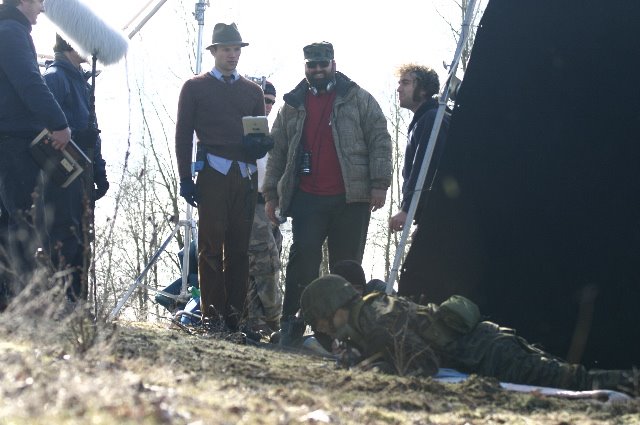
Subscribe to:
Posts (Atom)